Hotel business intelligence (BI) is a data-driven, software-powered process of collecting, analysing and visualising data from internal systems (PMS, POS) and external sources (competitor rates, market trends). By consolidating and crunching this fragmented information, hoteliers can identify trends that would otherwise be invisible and use these insights to make better strategic decisions about running the hotel.
For many hotels, data management involves a mountain of spreadsheets, which leads to inconsistent reporting across teams and properties. Modern property management systems (PMS), channel managers and revenue systems generate vast amounts of information, but this valuable data often remains siloed. Hotel business intelligence bridges this gap by automatically pulling these disparate data streams together, allowing owners and operators to trade the manual handling of CSV files for real-time visibility into the hotel’s performance, and transforming raw numbers into clear insights.
Rather than waiting for end-of-month reports that are already outdated by the time they hit your desk, hotel BI provides a real-time pulse check. This level of visibility is now critical for hotels that face growing competition and ever-shifting market conditions.
Hotel business intelligence software like SiteMinder Insights allows you to hand off the manual admin to technology, and gain instant insights like local competitor benchmarks, rate parity, changing market demand and evolving guest behaviours.
Table of contents
Why do hotels need a business intelligence solution?
A hotel business intelligence solution is essential for moving beyond the limitations of manual reporting and siloed property data. Humans simply aren’t efficient or effective at crunching data, but technology is. Hotel BI provides the visibility required to standardise KPIs across your hotel or property portfolio, to ensure every team or site is working from the same playbook, and that you consistently improve efficiency and capture more revenue.
Modern hotels don’t suffer from a lack of data – if anything, the opposite is true, and the issue is how to manage it all. Relying on your team to manually export reports from a PMS or channel manager into a spreadsheet is a recipe for human error and also results in delayed insights.
Dedicated hotel business intelligence software trades admin for automation, human error for consistent accuracy, and delays for real-time insights. You get hours of your time back while enjoying an unfettered, real-time look at what is actually happening both within your hotel and beyond.
Business intelligence also solves the problem of data inconsistencies across hotel chains. In multi-site businesses, property managers often track performance differently to one another. Without a standardised approach, it can be impossible to get a genuine and valuable comparison of their performance.
This kind of cross-functional alignment is already becoming the norm: 82% of hospitality leaders now report that their business and IT teams are aligned on strategic direction, a shift that BI tools both enable and accelerate.
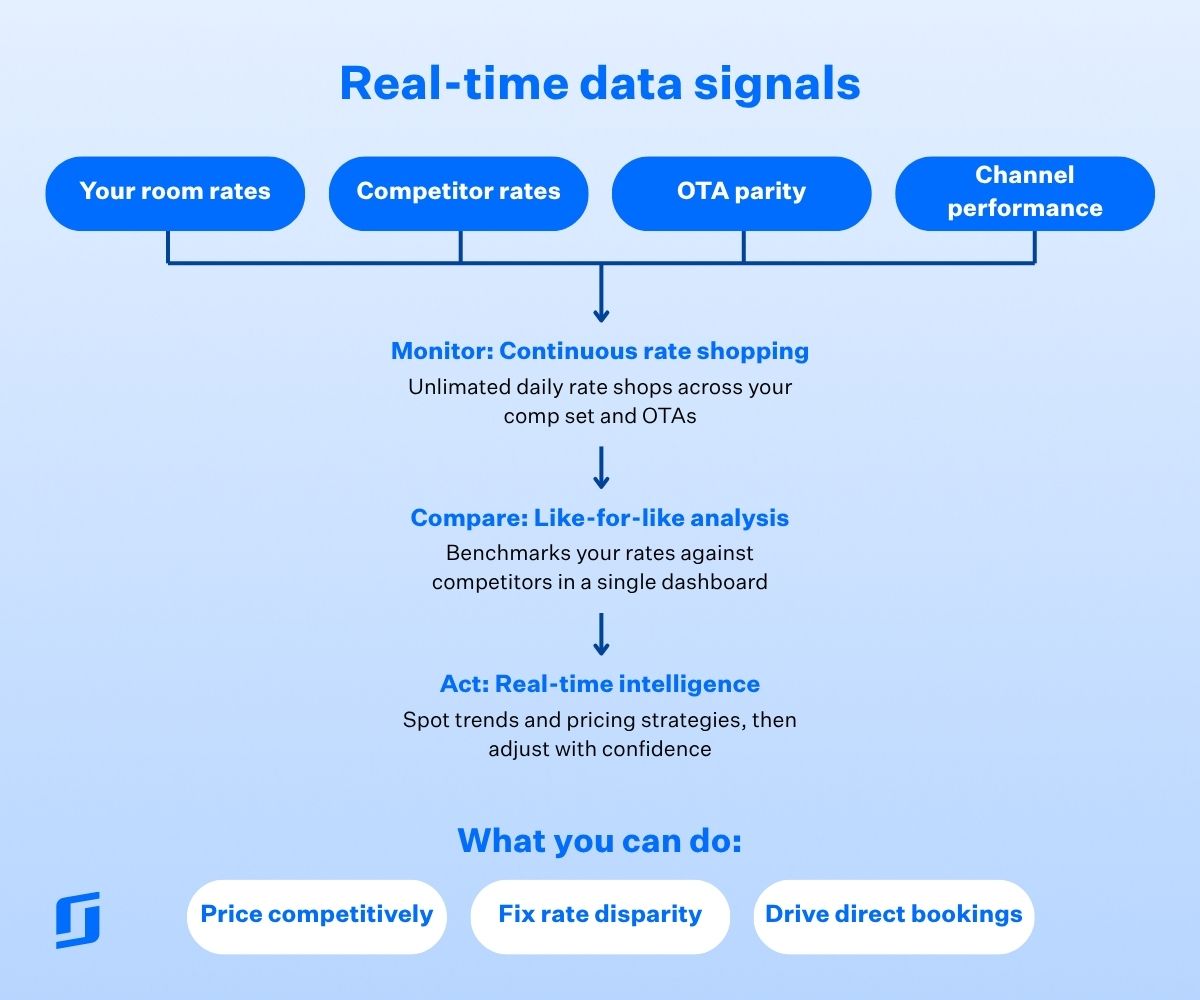
This clarity is particularly powerful when it comes to your distribution strategy. With the help of smart tools you can immediately see if your rates are out of parity or if a competitor is gaining ground within a specific market. Instead of reacting to yesterday’s news, you gain access to insights that allow you to:
- Spot revenue leaks before they impact the bottom line.
- Benchmark your rates and performance against competitors to ensure you’re not leaving money on the table.
- Track demand in real time and adjust pricing and marketing spend to suit.
Ultimately, hotel BI turns data into a practical, day-to-day tool that helps you make better, faster decisions and stay ahead of your competition.
Key takeaways
- Automation saves time and facilitates faster, more accurate decision-making by automating manual, spreadsheet-based processes.
- A single source of truth ensures every team and property works from an identical knowledge base.
- Access to real-time data allows you to monitor competitor rates and ensure your offering is always the most compelling on the market.
Turn fragmented data into a unified view with SiteMinder's ecosystem
Connect your PMS, channel manager, booking engine and revenue tools into one platform. SiteMinder integrates with 450+ channels and thousands of hotel technology providers so your BI insights are always complete and accurate.
Explore SiteMinder integrations
How does hotel business intelligence work?
Hotel business intelligence works by automatically aggregating data from core systems like your PMS, channel manager and revenue tools into a single cloud-based platform. It then analyses this data and presents it within a visual dashboard, usually in real time, highlighting trends, insights and opportunities that would otherwise be hidden within the zeroes and ones of disparate systems.
At its core, hotel BI is about connectivity. Cloud-based deployment is now the standard model for hospitality technology, accounting for nearly two-thirds of the hotel and hospitality management software market according to recent industry data. This means BI tools no longer require on-premise servers or a dedicated IT infrastructure as they’re now accessible from anywhere, and they update in real time.
Many hotel businesses struggle to keep up with their competition because their data is siloed; one site’s PMS doesn’t talk to another’s, real-time booking data isn’t featured in the latest financial reports. Hotel business intelligence software acts as a digital bridge, pulling all this info into a unified view without your staff needing to spend hours exporting and organising spreadsheets as it’s all done instantly and automatically.
Hotel BI systems follow a three-step process to turn data into insights:
- Automated data collection: The BI tool is integrated with your existing tech stack, allowing it to constantly pull data from all your different systems.
- Standardisation and processing: The software cleans and organises the data so that booking information or metrics like RevPAR mean the same thing for teams and properties across your hotel business. This allows you to accurately compare performance, rates, trends and more across your organisation.
- Visualisation of data and insights: The processed data is presented in intuitive dashboards that allow you to pull out relevant insights – rate parity issues, sudden demand spikes – which you can act on immediately.
For a more detailed breakdown of how these systems operate across different hotel types, Lighthouse’s guide to hotel business intelligence offers additional context.
If, for example, you run a medium-sized hotel chain with locations across the US, a BI tool lets you wake up and instantly see exactly how your Florida property is performing compared to your Texas hotel – or how both are faring against their local competitors – all from a single screen.
Modern hotel business intelligence tools handle enormous complexity under the hood, but they’re designed to be simple and intuitive to use. You don’t need a degree in data science to operate them, you simply need to know the numbers that matter to your business, which the business intelligence software will instantly and intuitively present to you.
For most mid-sized hotel groups, implementation follows a similar pattern: connect your PMS and channel manager via the BI provider’s API, map your existing data fields into the platform’s standardised format, and you’ll typically have a working dashboard within a few days. No data team or technical background is required since the heavy lifting sits with the software, not your staff.
Key takeaways
- Hotel BI tools connect disparate hotel systems to eliminate data silos and offer up a unified view of performance.
- The standardisation powered by automation ensures metrics mean the same thing at every property, and that they power more accurate comparisons.
- Intuitive, visual dashboards turn complex data into clear insights that you can efficiently understand and effectively action.
Optimise your pricing and maximise room revenue
SiteMinder connects with leading revenue management systems to automatically update your optimised rates across all distribution channels in real-time, maximizing the yield of every room through intelligent pricing.
Learn More
How does hotel business intelligence improve decision-making for hotel owners?
Hotel BI transforms decision-making from a game of guesswork and gut feel into an exercise defined by precision and confidence. By centralising all the relevant performance metrics, you can identify where you’re leaking revenue and where your most compelling opportunities lie. You can also do all of this in real time, and with total confidence that you’re leaning on accurate information.
The numbers reinforce why this shift matters:
- Highly data-driven organisations are 3× more likely to report significant improvements in decision-making.
- Companies in the top quartile for data adoption are 6% more profitable than their less informed competitors (increasing to 9% if this adoption is sustained for five years).
- Hospitality groups that transitioned to data-driven pricing engines from traditional methods saw a 22% increase in RevPAR.
Benchmark against competitors
You can’t win a race if you don’t know where your competitors are. Hotel business intelligence software allows you to monitor the rates and availability of hand-selected competitors, and can do so across multiple markets and regions. This visibility prevents you from being underpriced during peak demand or overpriced when the market dips – you can stay one step ahead of your local comp set, and say goodbye to decisions based on old data or gut feel.
Market demands
Demand can change quickly, from spikes caused by local events, to sustained trends driven by economic shifts or changing behaviours within your target market. Hotel business intelligence tools allow you to spot these trends as they emerge, rather than weeks or months later in a retrospective report. By recognising these patterns early you can market your business and staff your property appropriately, and set your rates at a level that secures bookings while generating maximum revenue.
Dynamic pricing
Static rate sheets are a guaranteed way to leave money on the table. With the help of business intelligence tools, you can set up dynamic pricing that sees your rates rise and fall in response to demand. When occupancy levels are high, dynamic pricing responds by increasing rates for the remaining rooms. When demand is slower, such as in low season, BI can compare your rates against those of your competitors to ensure you’re presenting the most compelling deal possible. These systems provide a clear, data-backed mandate for price changes, ensuring your rates are always optimised for current market conditions.
Optimise channel profitability
Not all bookings are created equal, and a high occupancy rate does not always lead to a healthy bottom line. BI provides visibility into which channels are delivering the best margins after commissions and acquisition costs are accounted for. By analysing channel performance across all properties, you can shift your distribution focus toward the most profitable streams, such as commission-free direct bookings, and stop over-relying on high-cost platforms like OTAs that can charge 15%, 20% or even 25% of the total booking value in fees.
Key takeaways
- Real-time competitive benchmarking allows you to monitor competitor rates and availability to maximise your revenue on every room.
- Proactive demand tracking allows you to identify market shifts early and adjust your staffing levels and marketing spend.
- Dynamic pricing and channel optimisation maximise RevPAR by adjusting rates and prioritising high-margin booking streams.

Alexandra Rolton,
Strategic Sales & Key Account Manager
Brady Hotels & Apartments
What should you look for in hotel business intelligence software?
The right hotel business intelligence software should eliminate data silos and serve as a single source of truth for your hotel business, especially if you manage multiple properties.
To find the right BI software for your property or hotel chain, you should look for a few key characteristics that help you to move beyond basic data collection:
- Hospitality-specific architecture: Generic BI tools often require a dedicated data team to set up and maintain. The best solutions for hoteliers are industry-specific, built by those who understand key metrics like RevPAR, ADR and lead times. This ensures the software speaks your language and works more or less out of the box.
- Seamless system integration: A BI tool is only as powerful as the data you feed it. Leading platforms connect directly to your PMS, channel manager, direct booking engine and payment processor, to ensure all relevant data flows seamlessly into the software, and that your reports are always accurate and up to date. When evaluating options, it’s also worth considering how a BI tool’s pricing structure scales with your portfolio. Some platforms charge per property, while others offer portfolio-level plans.
- Portfolio-level visibility: For operators managing multiple sites, the ability to standardise KPIs and compare performance between properties is essential. The best tools allow you to map different charts of accounts into a single, unified format so you can compare apples with apples. The right solution will also be able to scale with your hotel business as it grows.
- Forward-looking insights: While historical data can paint a picture of where you’ve come from and where you’re at, the top hotel business intelligence software focuses on the future. Features like real-time competitor rate tracking, demand forecasting and rate parity alerts allow you to predict your performance and proactively adjust your strategy to optimise it.
 One example of a tool that brings all these features and functionalities together: SiteMinder Insights. A leading example of hotel-specific BI technology, it’s designed for multi-property operators who are looking to benchmark against their local competitors, track changing demand trends, and maintain rate parity across markets from a single, intuitive interface. By drawing on data from over 50,000 hotels and 450+ distribution channels, SiteMinder Insights offers a depth of market intelligence that standalone BI tools simply can’t replicate, turning the data your hotel generates into bookings and revenue.
FAQs on hotel business intelligence
How easy is it to integrate hotel business intelligence?
Once your hotel business intelligence platform is connected, integration is largely hands-off. Data from your PMS, channel manager and booking engine syncs automatically in the background, so dashboards stay current without manual exports or scheduled uploads. If you add a new property to your portfolio or connect an additional distribution channel, the BI tool extends to cover it, typically within hours, with no re-configuration of your existing setup.
Ongoing maintenance is minimal. Software updates, security patches and new feature rollouts are handled by the vendor on the cloud side, meaning your team doesn’t need to manage infrastructure or worry about version compatibility. The result is a system that scales quietly alongside your business, keeping your data unified and accurate as your operation grows.
How does business intelligence support revenue management?
Business intelligence is the engine that drives smart revenue management. It provides the real-time insights that power both dynamic pricing and demand forecasting. Rather than rely on historical trends that may no longer be relevant, BI tools bring market signals to the surface – competitor rate changes, spikes in local demand – and help you to adjust your pricing strategy instantly in response.
BI can also help you to identify revenue leaks across your distribution channels. You can see exactly which booking sources are charging the highest commissions and providing the highest net margins, allowing you to prioritise the most profitable streams. It provides a data mandate that allows you to confidently raise rates during peak periods or launch targeted deals to fill empty rooms in low season.
How does business intelligence help a hotel compete in a volatile market?
In a volatile market where booking patterns and guest preferences can shift overnight, BI offers your hotel the agility you need to move from reactive to proactive management. By monitoring forward-looking data like OTA search trends and airline capacity, BI tools can anticipate demand before it hits your PMS. You can adjust pricing before your competitors and capture significantly more revenue during peak demand windows.
BI also helps you maintain rate parity and brand integrity during demand fluctuations. When the market becomes unpredictable, your BI platform ensures that your entire team stays aligned in terms of KPIs by presenting a unified view of performance. This avoids panicked pricing decisions and ensures everything from staffing levels to marketing spend is grounded in market realities rather than intuition.