What is hotel maintenance?
Hotel maintenance is the ongoing process of inspecting, repairing and servicing a property’s facilities, systems and equipment to ensure everything remains safe, functional and presentable. It extends the life of your hotel assets, reduces costly breakdowns, and ensures a positive guest experience.
Hotel maintenance is a critical operational function that aims to preserve both the physical condition and aesthetic appeal of the property. Depending on the size of the hotel, it may be undertaken by members of staff, a dedicated team, or a third-party provider.
Property upkeep includes back-of-house maintenance on systems and infrastructure that ensure the hotel functions properly (air conditioning, electrical, plumbing), and front-of-house maintenance that makes the property more presentable (furniture, landscaping, pool areas). It encompasses three main types of work:
- Preventive maintenance: Regular inspections and servicing to avoid failures.
- Corrective maintenance: Fixing issues as they arise.
- Predictive maintenance: Using data to anticipate repairs before problems occur.
This blog will explain how proper maintenance can reduce costs, support compliance, enhance the guest experience, and put a hotel in a position to make more money.
Table of contents
Why is hotel maintenance important?
Hotel maintenance is vital because it protects a hotel’s assets and reputation, and ensures guests enjoy a safe, comfortable and appealing experience. Regular maintenance keeps operations running smoothly and reduces the likelihood of costly issues and breakdowns. It ultimately leads to greater guest satisfaction and loyalty, resulting in more bookings and revenue.
Hotel maintenance plays a central role in both day-to-day operations and long-term business success. A well-maintained property creates a positive first impression and can directly influence guest reviews and loyalty. Preventive maintenance helps to avoid equipment failures that could disrupt service – air conditioning issues, power outages, plumbing leaks – while ensuring compliance with local health, safety, and building regulations.
Proper upkeep of infrastructure like electrical fixtures, lifts and HVAC systems also helps to reduce energy costs and extend the lifespan of valuable assets. The benefits extend beyond the technical and financial: consistent maintenance creates a culture of efficiency and supports staff morale. Employees can deliver better guest experiences when systems function reliably.
Key takeaways
- Regular maintenance protects assets, prevents breakdowns and keeps hotel operations running smoothly.
- Well-maintained facilities boost guest satisfaction, reviews and long-term loyalty.
- Consistent upkeep lowers energy costs, extends asset life and supports staff efficiency.
Streamline your hotel operations with SiteMinder
Optimise staffing, reduce costs, and improve guest satisfaction with a platform that gives you real-time insights and control across your hotel operations.
Learn about our platform
What are the hotel maintenance department’s roles & responsibilities?
The hotel maintenance department is responsible for the upkeep of the physical property and its various mechanical, electrical and plumbing systems. It ensures every asset, from TVs to hot water systems, operates safely, efficiently and as it should, which in turn makes the team’s job easier and the guests’ experience better.
Effective maintenance is a critical component of successful hotel management strategies because it protects the hotel’s long-term capital value – it ensures assets last as long as possible before they need to be repaired or replaced, which is closely tracked by back office finance and procurement teams.
By understanding the intersection of different hotel departments and building functions, maintenance teams can coordinate with teams like housekeeping to address faults before they impact the guest experience, or with front desk staff who receive reports of issues from guests. This collaborative approach allows the maintenance team to operate effectively across both front-of-house and back-of-house environments.
In larger hotels and chains the maintenance department can be made up of a number of specialised team members:
Front of house
Responsible for maintaining the guest-facing elements of the property, and working closely with the front office, front-of-house maintenance staff include:
- Guest room technician: Performs repairs within guest suites, fixing items like leaking taps, broken furniture and faulty TVs.
- Public area technician: Maintains the safety and functionality of the lobby, hallways and restaurants by monitoring elements like lighting and automatic entry systems.
- Painter and decorator: Keeps the hotel looking new by touching up damaged surfaces and applying fresh paint.
- Groundskeeper: Maintains the hotel grounds by managing landscaping, swimming pools and car parks.
Back of house
Responsible for maintaining the elements of the hotel that guests don’t see, but that still form a key element of the guest experience, the back-of-house team works closely with internal teams, and is often focused on preventive maintenance:
- HVAC engineer: Oversees the industrial heating, ventilation and air conditioning (HVAC) systems that control the climate within the hotel.
- Plant room operator: Manages any heavy machinery required for hotel operations – particularly within larger properties – including boilers, water pumps and generators.
- Kitchen technician: Specialises in repairing industrial catering equipment such as walk-in fridges, high-pressure dishwashers and ovens.
Key takeaways
- Front-of-house maintenance covers guest-facing elements like room repairs, public areas, painting and groundskeeping.
- Back-of-house maintenance focuses on critical infrastructure including HVAC, plant machinery and kitchen equipment.
- Effective maintenance teams coordinate across departments like housekeeping and front desk to resolve issues before they reach guests.
What can you commonly find in a hotel maintenance checklist?
A hotel maintenance checklist typically includes regular inspections of plumbing, electrical, HVAC and safety systems, along with checks on guest rooms, public areas and exterior facilities. Tasks can cover everything from testing smoke alarms and servicing lifts to repairing fixtures and mowing lawns. The goal is to ensure all areas of the hotel remain safe, functional and visually appealing.
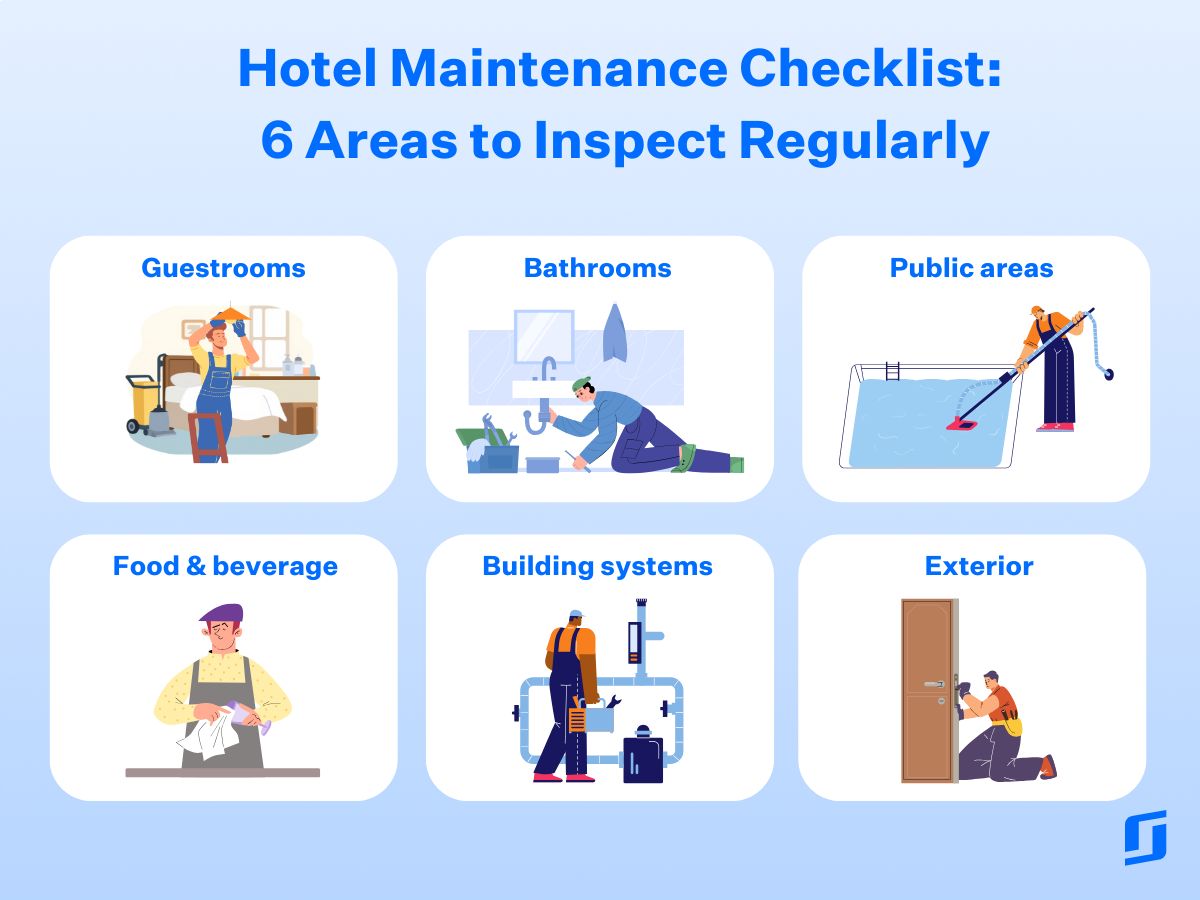
More specifically, a hotel maintenance checklist might include the following items:
- Guestrooms: It’s critical to ensure that all in-room amenities work, and that any issues, from blown lightbulbs to broken beds, are fixed instantly.
- Bathrooms: Check for loose fittings and fixtures, and fix dripping taps, shower heads and cisterns. Regular deep cleaning of wet areas prevents built-up grime and mold.
- Public areas: A well-maintained lobby ensures a guest’s first impression is a good one. Hotels are often chosen based on amenities like gyms and swimming pools, but if poor maintenance means they don’t meet expectations or create safety concerns, a hotel damages its reputation.
- Food & beverage areas: Maintenance in F&B areas is a matter of compliance. You need to ensure bars and kitchens meet regulatory standards, while also creating a well-functioning and aesthetically pleasing space that guests will want to enjoy.
- Building systems: Guests expect perfect comfort during their stay, so it’s critical to create a hotel preventive maintenance checklist that covers HVAC, plumbing and electrical systems. Ensuring these systems operate efficiently also helps a hotel to maximise profitability.
- Exterior: Particular care needs to be taken of hotel elements that are exposed to Mother Nature. Create maintenance checklists for the doors, windows and facade of the building; gardens, landscaping and irrigation systems; car parks, paths and other thoroughfares; and any roof-mounted machinery, equipment and assets.
Key takeaways
- A hotel maintenance checklist covers all key areas, from room fixtures to utilities to the building itself.
- Regular inspections ensure operational efficiency, regulatory compliance, and guest safety and comfort.
- Preventive maintenance protects assets, enhances the guest experience and upholds the hotel’s reputation.
How does proper hotel maintenance affect bookings & revenue?
Proper hotel maintenance directly increases revenue by boosting guest satisfaction, generating positive reviews, and preventing costly repairs and room outages. Well-maintained properties command higher booking rates, reduce operational costs through preventive care, and build brand loyalty that drives repeat business and referrals.
Market data on maintenance costs:
- Hotels typically spend 8-12% of operating revenue on maintenance activities. This range forms a benchmark many use to plan maintenance budgets.
- According to some reports, over 70% of hotel guest complaints originate from room problems such as broken equipment and issues with climate control.
- Recent research found that guest satisfaction with hotel maintenance had declined notably, with the blame placed on rising maintenance costs.
The benefits of a thorough and holistic approach to hotel maintenance are many and varied, particularly in terms of securing bookings and maximising revenue:
Boost guest satisfaction & reviews
Guests see maintenance as a fundamental function of a hotel, so evidence of less-than-perfect upkeep can result in a reputational hit through online reviews and word of mouth. On the flipside, a well-maintained property can earn great reviews that are key to building the reputation of your hotel business, spreading the good news online and through personal networks.
Higher booking rates
With maintenance fuelling positive reviews and word of mouth marketing, it can play a significant role in generating new business for hotels. And when everything works precisely as it should in the hotel, new guests are more likely to become loyal return customers.
Reduce costly repairs
Aside from negatively affecting the guest experience, critical failures in complex infrastructure like HVAC systems can be expensive to fix. Preventive and predictive maintenance keep a hotel business running smoothly by dealing with potentially significant and costly issues before they arise.
Reduce revenue loss
Proper maintenance helps to avoid situations in which a hotel’s rooms and amenities go out of service, which can lead to lost revenue or reputational hits from disappointed guests. It also ensures all hotel systems run as efficiently as possible, minimising operational costs.
Strengthen brand loyalty
The key to earning loyalty from hotel guests is to offer a consistently high quality experience. Fully committing to a hotel maintenance schedule forms the foundation of that quality and consistency, by ensuring everything works as it should, and freeing up staff to enhance guest stays in unique and personalised ways.
Key takeaways
- Well-maintained hotels boost guest satisfaction and reviews, directly drive new bookings and return business.
- Preventive maintenance reduces the costly repairs, downtime and operational inefficiencies that can erode profit.
- A structured approach to maintenance empowers hotel staff to enhance guest experiences.
How do you measure hotel maintenance performance?
Measuring maintenance performance is a matter of tracking how effectively your team keeps property assets in good working order, all while minimising any disruption to guests. Key areas of focus include response times, and the balance between proactive and reactive maintenance.
Your ability to track, analyse and improve performance comes down to data. You need a set of quantifiable metrics that highlight how effective your maintenance crew currently is and where improvements can be made. These KPIs allow maintenance leaders and hotel management to justify budget spend and demonstrate how maintenance activities directly support the hotel’s overall profitability and guest satisfaction scores.
Key maintenance metrics include:
Average time to complete repairs
This KPI tracks the time from the moment a fault is reported to its final resolution. A low average repair time is essential for guest-facing areas, as lingering issues can lead to rooms being out-of-order for an extended period, which means lost revenue through room downtime and potential guest compensation. The aim should be to establish a baseline, then lower that number over time.
Work order completion rates
This KPI measures the percentage of assigned tasks that are finished within a specific timeframe, e.g. a week or a month. High completion rates indicate a well-managed team and a manageable backlog, whereas a falling rate suggests that either the team isn’t well managed, is understaffed, or is overwhelmed by aging or faulty equipment.
Preventive maintenance
Preventive maintenance is the act of performing scheduled inspections and servicing to stop equipment failure before it happens. A common split that many hotels aim for is 80% preventive maintenance versus 20% reactive maintenance. This ratio indicates a proactive approach that reduces the likelihood of catastrophic failure within a hotel’s most expensive assets, like HVAC, water and electricity generation systems, while also maximising their lifespan.
Reactive maintenance
Reactive maintenance covers ‘break/fix’ issues, where the team responds to unexpected failures reported by staff or guests. While some reactive work is inevitable, a high performing maintenance department will aim to keep these issues to 20% or less of their maintenance workload, with the focus on preventive maintenance. Going higher than that figure suggests the team is spending too much time responding to emergencies rather than preventing them, which can be costly for the hotel and disruptive for guests.
Cost per occupied room
This financial metric calculates the total maintenance spend (encompassing things like labour, parts and external contractors) divided by the number of rooms sold. It provides a clear view of how efficiently the department is operating relative to the hotel’s actual usage and helps identify broad trends in hotel maintenance.
Key takeaways
- Track average repair time and work order completion rates to measure team responsiveness and efficiency.
- Aim for an 80/20 split between preventive and reactive maintenance to reduce costly emergency fixes.
- Monitor cost per occupied room to benchmark maintenance spend against actual hotel usage.
How can you build a hotel’s preventive maintenance checklist?
Building a comprehensive hotel preventive maintenance checklist involves auditing every physical asset and categorising them by location, system type and service interval. The document serves as a roadmap for the department, ensuring no critical task is missed.
Different lists will generally be used for different areas of the hotel:
- Guest rooms: Inspecting door locks, testing electrical outlets and checking furniture for wear or safety hazards.
- HVAC systems: Cleaning condenser coils, replacing air filters and calibrating thermostats to balance efficiency and guest comfort.
- Plumbing and drainage: Checking for leaking pipes, testing shower pressure and inspecting water heaters for issues.
- Kitchen and laundry: Deep cleaning grease traps, checking gas connections and inspecting refrigeration units.
- Fire and safety: Testing smoke detectors, checking fire extinguishers and ensuring all emergency exit lighting is compliant.
- Electrical systems: Inspecting circuit breaker panels, testing backup generators and replacing light bulbs.
- Building: Clearing gutters and downpipes, inspecting external surfaces for damage and checking windows and doors.
- Pool and spa: Testing chemical levels, maintaining filtration systems and checking safety railings are secure.
How can owners stick to their hotel’s preventive maintenance checklist?
Hotels can maintain a consistent preventive maintenance schedule by making it someone’s responsibility (whether a team or individual), by properly training those responsible, and by implementing systems and tech to track the maintenance.
The importance of preventive maintenance:
- 84% of hotel guests say cleanliness and property condition directly influence their booking decision.
- Maintenance-related issues account for up to 30% of negative hotel reviews.
- Hotels that implement preventive maintenance reduce repair costs by 12–18% annually.
Allocate the task
While it can be tempting to push preventive maintenance down the to-do list, it’s critical that it remains a priority, as deferring the job can turn small issues into big, expensive and unsafe problems. Hotels can guard against this by assigning clear responsibilities for each task. Someone – whether an individual or the head of your maintenance department – needs to ultimately be accountable for the work.
Train your staff
A hotel needs to give its employees the knowledge and skills they need to succeed. Train your staff on preventive maintenance to ensure they know the issues to look for and how to fix them.
Create a maintenance schedule
The intricacies of preventive maintenance – exactly what needs to be done, and when – must be clearly defined. You should create checklists for regular, long-term and ad hoc maintenance, and establish clear systems and processes to ensure all work is completed on time, without fail.
Track maintenance with tech
How do you ensure all preventive upkeep is completed? Dedicated hotel maintenance software – also called hotel maintenance management systems – can help by automating reminders, tracking progress and monitoring completion rates. More general strategic planning efforts can also help to reduce the cost and disruption of maintenance. SiteMinder, for example, features occupancy forecasting that can inform hotel upkeep schedules by identifying low-demand periods where major maintenance will affect the fewest possible guests.
Key takeaways
- Categorise every physical asset by location and system to ensure no critical maintenance task is overlooked.
- Assign clear responsibilities and provide specific training to prevent small issues from becoming expensive repairs.
- Use maintenance software and occupancy forecasting to schedule major work during low-demand periods.
Integrate to SiteMinder’s vast ecosystem
Connect to SiteMinder’s extensive network of technology systems and partners to maximise your efficiency, bookings, and revenue.
Learn More
What is the best hotel maintenance app?
The most effective maintenance software turns reactivity into proactivity. These digital tools replace paper and phone calls with centralised task management, allowing the department to track the health of every asset across the property in real time.
- SiteMinder: A market-leading platform that provides the deep occupancy insights you need to effectively coordinate maintenance schedules.
- Hotelkit: An all-in-one operations platform that allows staff to log maintenance requests via mobile and follow progress through digital checklists.
- Akia: A communication-heavy tool that uses text-based workflows to bridge the gap between guest requests and the engineering team.
- Transcendent: A specialist asset management system designed to track the lifecycle of expensive machinery and predict when replacements are required.
While traditional apps are fine for logging a broken lightbulb, SiteMinder offers the strategic oversight that modern hotels increasingly demand from their tools. With real-time occupancy forecasting, managers can pinpoint low-occupancy windows where major maintenance can be completed, making SiteMinder the smartest tool in your maintenance toolbox.
Frequently asked questions about hotel maintenance
How much should hotels budget for maintenance annually?
On average, hotels allocate around 8–12% of their operating revenue to maintenance each year. This range is typically reliant on lower cost preventive upkeep, but is also designed to handle unexpected repairs.
Should hotels hire in-house maintenance staff or outsource?
The right balance depends on a hotel’s size, budget and infrastructure. Many hotels use a hybrid model, employing in-house staff for daily upkeep and outsourcing complex or seasonal tasks to specialists.
How do hotels track and schedule preventive maintenance?
Hotels often use property management software or dedicated computerised maintenance management systems (CMMS) to log tasks, set reminders and track work orders. These tools are designed to create schedules and ensure no potential issues are overlooked.
What hotel maintenance tasks are required by law?
Legal requirements typically include safety checks on lifts, fire systems, electrical wiring, gas fittings and emergency lighting, but you should contact your local authorities to understand your responsibilities in terms of health, building and environmental regulations.
How does preventive maintenance reduce operating hotel costs?
Preventive maintenance identifies and fixes issues early, reducing expensive emergency repairs. It also improves energy efficiency and extends the lifespan of key assets.
How can hotels minimise guest disruption during maintenance?
Hotels should schedule major maintenance during low occupancy periods or daytime hours when most guests are out. Using occupancy forecasting tools helps identify optimal windows, while clear communication with affected guests and offering alternative amenities can further reduce disruption.