What is hotel housekeeping?
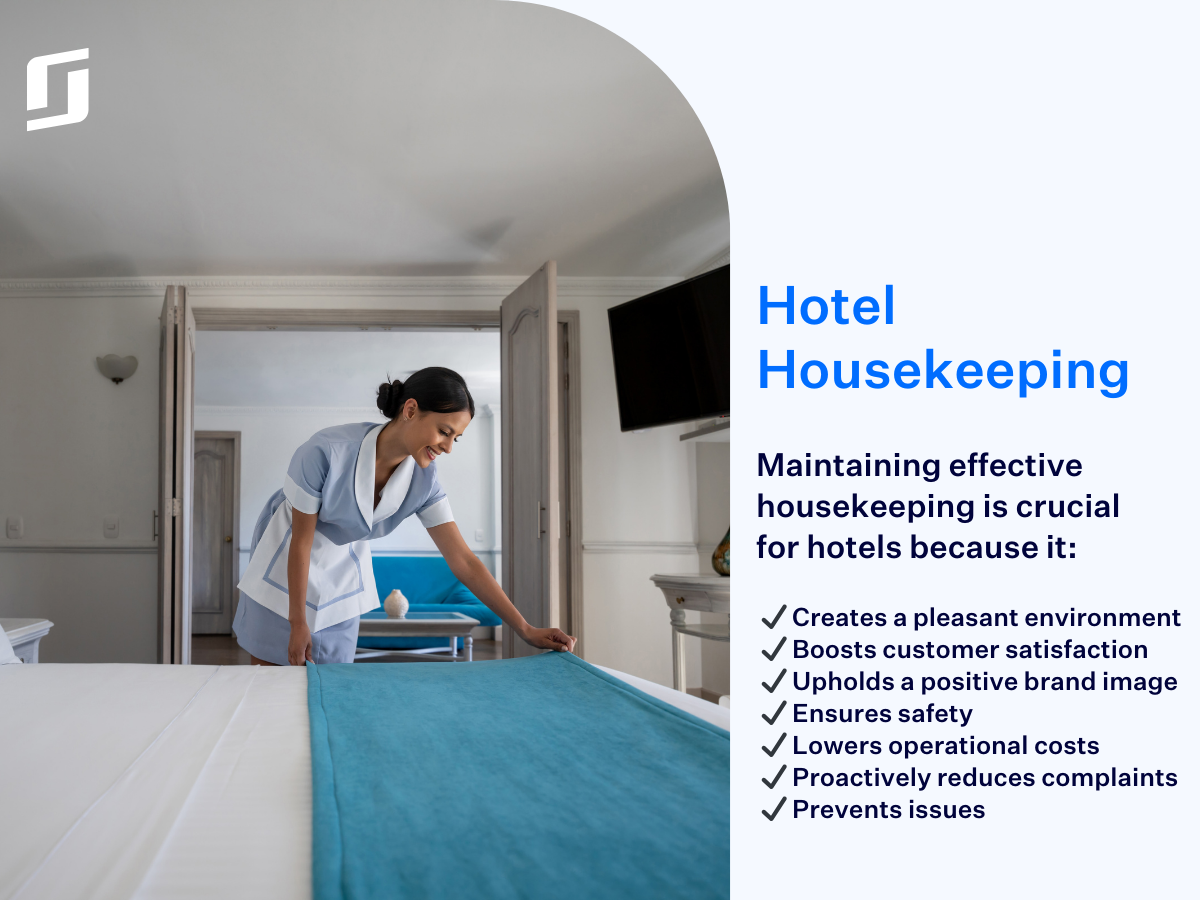
Hotel housekeeping is a hotel department charged with cleaning, tidying and organising the hotel. It is responsible for maintaining the aesthetics of the property and creating a safer, more welcoming environment for guests.
The size and shape of a hotel’s housekeeping department will depend on the size and shape of the hotel. Larger hotels will have multiple departments, each dedicated to a certain area or task. Smaller hotels will have a single department, or perhaps just one or two housekeepers, who are tasked with cleaning and maintaining the entire property.
Hotel housekeeping supplies are usually stocked in dedicated hotel housekeeping carts, which hold everything a team member might need to clean a room. It’s also common to delineate cleaners with a hotel housekeeping uniform so that guests know who to approach if they need cleaning assistance.
If you’re ready to brush up on all things housekeeping in hotel management, this blog covers everything from department structure and KPIs to cleaning checklists, scheduling, and the best management software that support your team. Table of contents
Why is hotel room cleaning so important?
Hotel room cleaning is important because it’s fundamental to the guest experience. An untidy or dirty room can never be overwritten, no matter how incredible the rest of a guest’s time at a hotel may be.
Hotel room cleaning is a relatively black and white space: you either get it right (and enjoy your guests’ contented silence) or you get it wrong (and deal with complaints). And when you get it wrong, the cost of repair is high and measured in the impact of a negative review and the lost trust of a customer who may never return. Even relatively neutral reviews can evoke shudders down the spines of potential guests when the specified cleanliness rating falls subpar.
With only one chance to get it right, housekeeping is a daily activity that has the power to make or break a guest’s experience and shines a spotlight on your team’s processes, as well as attention to detail.
In the pursuit of perfect processes and a suitable hotel room cleaning policy, hoteliers can turn to checklists, experienced housekeeping managers and software, with the goal of driving efficiencies alongside excellence.
More revenue, less work Organise your housekeeping department better and reduce your administrative workload with SiteMinder, the world’s leading hotel platform.
What does housekeeping do in a hotel?
The main role of housekeeping is daily hotel room cleaning, which, depending on how full the hotel is, may need to be squeezed into a few hours in the middle of the day. But the department is responsible for other areas too: lobbies, hallways and lounges, on-site bars and restaurants, and other common areas. Often an overnight team will clean the common areas of a hotel to minimise guest disruption.
The roles that make up the hotel housekeeping department vary depending on the size of the hotel. Larger hotels may have staff in charge of specific duties, whereas others will have general housekeeping staff who take care of all duties as part of one role.
Some job titles that often appear in hotel housekeeping departments include:
- Cleaning manager: The senior leader responsible for the department’s operations across the entire property, including budgeting, recruitment and maintaining standards.
- Assistant cleaning manager: Offers leadership support and relief when the manager is away, whether in shifts where they’re the highest-ranking member of the team, or as a second-in-command taking care of issues when the manager is otherwise engaged.
- Floor supervisor: Manages a team of room attendants on specific floors to ensure every relevant SOP is followed, and every room meets the hotel’s cleanliness standards.
- Public area supervisor: Oversees the upkeep of non-guest room spaces – the lobby, restaurants, pool areas, gyms – to ensure they are always clean and welcoming.
- Linen supervisor: Manages the inventory and quality of hotel linens, coordinating with the back office for procurement and replacement.
- Laundry supervisor: Responsible for the daily cleaning of towels, linen, tablecloths and uniforms, often at an on-site facility, to ensure a steady flow of clean laundry.
- Room attendant or housekeeper: The frontline staff members responsible for cleaning guest rooms, replenishing amenities and reporting maintenance issues.
- Public area attendant: Working under the instruction of the public area supervisor, they focus on cleaning and maintaining the high-traffic areas of the hotel.
- Linen room attendant: Working under the instruction of the linen supervisor, they handle the sorting, folding and distribution of linen to various rooms, floors and departments.
- Laundry attendant: Working under the instruction of the laundry supervisor, they operate the machinery used for washing, drying and pressing the hotel’s laundry.
How is a hotel housekeeping department structured?
For larger hotels, the housekeeping department follows a tiered hierarchy led by an executive housekeeper who reports to general management. Beneath them, assistant housekeepers, floor supervisors, and specialist leads (laundry, linen, public areas) oversee frontline attendants. This structure ensures clear accountability, quality control, and seamless coordination with the front desk and back office.
The specific shape of a housekeeping department depends on the size and type of property, but most follow a common chain of command.
Here’s how roles typically layer in a mid-to-large hotel:
Top-level management
Executive housekeeper (or director of housekeeping) sits at the top of the department and reports directly to the general manager or rooms division manager. All other housekeeping roles ultimately report into this position.
In larger operations, one or more assistant housekeepers sit directly beneath the executive housekeeper, with the mid-level supervisors reporting up to them.
Mid-level supervisors
Beneath assistant housekeepers, several specialist supervisory roles manage distinct areas of the operation:
- Floor supervisors oversee room attendants across assigned floors.
- Control desk supervisors serve as the coordination link between housekeeping and the front office.
- Laundry supervisors oversee linen and uniform attendants.
- Public area supervisors oversee housemen and public area attendants.
Frontline staff
The largest group in the department, frontline staff report to their respective supervisors and carry out the hands-on work:
- Room attendants report to floor supervisors.
- Linen and uniform attendants report to laundry supervisors.
- Housemen and public area attendants report to public area supervisors.
- Mini bar attendants typically report to floor supervisors or a dedicated F&B liaison.
- Specialist staff such as tailors, upholsterers, or florists (found in luxury or resort properties) report to the executive or assistant housekeeper directly.
How smaller properties simplify this structure
Not every hotel needs five layers of management. In properties with fewer than 50 rooms, the executive housekeeper often takes on the supervisory layer directly, with room attendants and other frontline staff reporting straight to them. For very small properties (under 20 rooms), the structure typically flattens to a single housekeeping lead with two or three attendants beneath them. A property management system typically fills the coordination role that a control desk supervisor would occupy in a larger hotel.
What should your hotel room cleaning policy include?
A hotel room cleaning policy should include both broad and specific information, from a description of the overall “vibe” that your hotel is trying to achieve (and how room cleaning contributes to that), to specific products to be used, processes to be followed, and checklists to assist with thoroughness and consistency.
A hotel room cleaning policy lays the foundation for all housekeeping-related activities. It usually includes:
- The vision, which provides an opportunity to align with the hotel’s brand and goals,
- House-specific standards, such as products used,
- Guidelines for conduct, including engagement with guests and reporting faulty appliances,
- Procedures for public areas and back of house by frequency and
- Checklists by room type for cleaning during a guest’s stay, turn-down service and turnovers between guests.
Thorough training on policies addresses more unusual scenarios and provides general guidance to align the housekeeping team’s actions with the hotel’s values.
Where a hotel room cleaning service is brought in, the room cleaning policy may form part of the agreement between the hotel and the hospitality cleaning service and set clear standard operating procedures.
How do you measure housekeeping performance and quality?
In assessing housekeeping performance, the two main considerations – efficiency and quality – can work against one another. But by monitoring a range of metrics, you can gain a clear picture of staff performance. The goal is to strike the perfect balance between the productivity that the business needs and the pristine environment that guests expect.
| KPI | Industry benchmark |
|---|---|
| Room cleaning time | 20-30 minutes (stayover) / 30-45 minutes (check-out) |
| Rooms per attendant | 12-18 rooms per 8-hour shift |
| Quality inspection score | 90% or higher pass rate |
| Vacant-to-clean turnaround | Under 60 minutes from guest departure |
| Cleaning cost per room | $3-$10 (labour and supplies) |
Note: Benchmarks sourced from ProStay. Standards may differ based on specific hotel policies and property type.
Room cleaning time
This tracks the average time that it takes to clean a room. There is typically a difference in the average time it takes to clean an occupied room versus a room that a guest has just checked out of.
Rooms per attendant
This metric identifies the average daily workload for each staff member, and can help managers to ensure that productivity targets are met without overwhelming or burning out the team.
Quality inspection score
This score reflects the accuracy of the cleaning process by measuring how many rooms meet the hotel’s internal requirements during random supervisor checks.
Vacant-to-clean turnaround time
This measures the total time elapsed from a guest checking out to the room being marked as ready for the next arrival in the system.
Resource & cost management
The total spend on labour, supplies, linen, and equipment divided by occupied rooms in a given period. Most mid-range hotels benchmark this between $3 and $10, though the range varies with property type and service level.
Guest feedback
Online reviews and internal satisfaction surveys regarding room cleanliness can serve as a vital benchmark for the effectiveness of housekeeping.
What should be on a hotel housekeeping checklist?
Whether you are writing a checklist for your run-of-house or your suites, the overall approach will likely be the same: top to bottom and removing things before restocking. This means you start cleaning up high and finish with the floor.
Procedures and checklists are often segmented by the two separate areas to clean.
Hotel bedroom cleaning checklist
- Open the windows
- Remove linens, rubbish, or debris
- Dust surfaces, starting at the highest points (so any dust swept up here can get cleaned off the floor later)
- Arrange & create order, such as hangers in closet, menus on desks, and ironing boards returned to their storage
- Wipe and sanitise surfaces, including doorknobs and handles
- Make the bed
- Restock amenities
- Check that appliances are working, including lightbulbs
- Finish with signature touches
- Vacuum or mop the floors
- Final look (and close that window)
Hotel bathroom cleaning checklist
- Remove towels, mats, rubbish, or debris
- Arrange & create order, such as hair dryers clean and neatly packed away
- Clean & sanitise surfaces, including towel rails, cabinet handles and doors, showers, tubs, sinks, and drains
- Clean & sanitise toilet and bidets
- Restock amenities, including towels, toilet paper and toiletries
- Check that appliances are working, including hot water
- Finish with signature touches
- Mop the floors
- Final look
Integrate to SiteMinder’s vast ecosystem
Connect to SiteMinder’s extensive network of technology systems and partners to maximise your efficiency, bookings, and revenue.
Learn More
What are the best hotel room cleaning tips you need to know?
Professional hotel room cleaning is predicated on easy to follow systems and processes that ensure no surface is overlooked and efficiency is maintained. By making SOPs and quality control second nature, and by picking up a bit of insider knowledge along the way, attendants can deliver a pristine environment within tight turnaround times.
Hotel housekeeping hot hints:
- Streamlining housekeeping can cut room turnover time by ~15–20%, reducing labor costs and enabling faster room availability.
- Efficient workflow improvements in one mid-size hotel reduced housekeeping activities by nearly 24% and walking distances by nearly 66%.
- Organisations that incorporate guest feedback into housekeeping processes see a ~15% rise in positive service feedback and fewer cleanliness complaints.
No matter how experienced a hotel cleaning team may be, there are always more tips, tricks and tactics to use. Here are a few of the most effective:
- Now you have read of ‘signature touches’ twice, it’s time to define yours: it could be as simple as a hotel-branded chocolate on the nightstand or as detailed as a personalised greeting note on the mirror.
- Create efficiencies through clarity: the differences between cleaning the room of an in-house guest as opposed to a full turnover should be clear and result in both happy guests and less time spent turning down a room vs turning over a room.
- Have clear checklists for room types that are not run-of-house. This may include instructions on how to clean or maintain special gear such as jet tubs or gym equipment.
- Forecast hotel room cleaning times and staffing based on occupancy level. This begins with knowing how long a full room turnover takes and how many are scheduled for the day.
- Pay attention to ‘use by dates’ when replenishing amenities, toiletries, or refreshments. No one wants to find an expired camomile tea bag with their Nespresso.
- Use cleaning supplies and products that do not have a distinct or overpowering smell.
- Schedule regular checks of all appliances, change of filters for air conditioners or cleaning of ducts. These may be relatively more time-consuming or costly but pay off greatly when compared to guests complaining about issues with appliances such as functionality, noise or bad smells that cannot be masked.
- Standardise the organisation of your housekeeping carts and ensure they are easy to move around your hallways, rooms and carpets.
- Schedule regular deep cleans of windows, carpets, guest rooms, public areas and the back of house.
- Update housekeeping checklists when new amenities are added.
- Reward your housekeeping team with recognition and empower them to speak up about recurring or emerging issues. It is much better to learn about towel racks coming loose from a team member than from a guest.
- The last of our hotel housekeeping tips: get back to the floor with your team and experience what a routine turnover in your hotel looks like.
Key takeaways
- Create distinct checklists for turn-downs, full turnovers, and specialty rooms with unique equipment. Standardise your housekeeping carts for efficiency, select cleaning products with neutral scents, and always verify expiry dates when restocking amenities.
- Know your average turnover time to forecast staffing needs based on occupancy levels. Build in regular deep cleans for all areas and preventative maintenance for appliances, filters, and ducts; addressing these proactively prevents unfixable guest complaints later.
- Empower your housekeeping team through recognition and encourage them to report emerging issues before guests notice them. Regularly work alongside your team to understand their challenges, refine processes, and perfect those signature touches that make rooms feel special.
Matthias Gerber,
Co-owner
Town Hotel
How do you manage housekeeping labour and scheduling effectively?
To effectively manage a housekeeping team, you must ensure rooms are ready when you need them, while also being careful not to overspend on payroll. The key is aligning staffing levels with occupancy forecasts and using real-time data to adjust shifts based on demand.
Choosing the right staffing model
In-house or outsourced? Hotels must decide whether control or flexibility is more important, though a hybrid approach often works best, as it allows you to maintain a core team of full-time staff, then bring in casual workers during peak periods.
Managing schedules
Scheduling should be based on a rolling occupancy forecast, rather than a static weekly template. Staggered start times and shift patterns can ensure that the highest number of attendants are on-site during the crunchtime between the hotel’s check-out and check-in times.
Standardising cleaning times
Establishing a baseline time for different cleans helps managers to calculate the exact hours required for a given day’s occupancy. This enhances transparency, prevents uneven workloads, and provides a clear benchmark for evaluating performance.
Integrating housekeeping and front office systems
Giving the housekeeping team access to your Property Management System (PMS) replaces the errors and inefficiencies of paper lists with a real-time view of cleaning as it happens. Attendants can see check-outs in real time, immediately start cleaning, and mark the room as soon as it’s ready, allowing the front-desk to delight guests with early check-ins.
Coordinating with front office and maintenance
The front office needs real-time room status updates to manage early check-ins and room moves, while housekeeping needs advance notice of VIP arrivals to prioritise accordingly. A shared workflow for these handoffs, whether through a PMS or a simple status board, keeps both teams aligned.
On the maintenance side, room attendants are often the first to spot issues like leaking taps or faulty air conditioning. A clear process for logging faults during a clean and routing them to maintenance in real time prevents small problems from becoming guest complaints.
What hotel housekeeping management system should you use for easy hotel room cleaning?
Hotel housekeeping management systems can significantly reduce some of the aches, pains and challenges of everyday cleaning duties. This includes things like review management software that highlights recurring issues, to team and schedule management tools that ensure that every room gets the attention it deserves.
Nowadays, perhaps the best hotel room cleaning tips no longer come in the form of checklists, but as tech recommendations. Even unexpected sources such as review management software can let a hotel identify an issue with the smell in their elevators—simply by arranging a word cloud based on the most mentioned words in reviews. Beyond identifying issues, creating efficiencies and excellence through streamlined processes sounds simple until numerous other factors impact a hotel’s daily operations and a guest calls to ask about a late check-out.
While your team pursues their daily dance of balancing standard procedures with emerging guest requirements, it makes sense to invest in technology that saves time. Not only may this result in a cost-saving when the need for housekeeping staff is accurately projected, but it may smooth communication between teams and provide much-needed visibility.
One example of software that can assist with housekeeping is HKeeper in the Siteminder App Store, which also offers an opportunity to manage other tasks, such as maintenance, to-dos, internal communication and general employee management. A hotel housekeeping management system that integrates with a hotel’s PMS uses inventory and reservation data to project staffing needs, forecast when rooms will be ready, and ensure your team’s time is spent where it matters most.
Next steps
- Let software do the heavy lifting. Pick housekeeping tools that integrate with your PMS to pull live reservation data, forecast staffing needs, and predict room-ready times.
- Mine your reviews for fixes you cannot see on a checklist. Use review analytics and word clouds to surface recurring issues like odours or slow turnarounds so you can act before complaints build.
- Keep teams in lockstep. Use task and schedule management to assign work, handle late check-outs in real time, and centralise maintenance and to-dos so housekeepers spend time where it matters most.
What is the best hotel housekeeping management software?
The best housekeeping software acts as a bridge between the front desk and the cleaning crew, allowing everyone to see room statuses and staff workloads in real time. Leading solutions feature PMS integrations, automated room prioritisation and digital inspection checklists. Examples of top tools include:
- Hotelkit: A comprehensive platform that features automated room assignments and digital checklists.
- Actabl (ALICE): Combines labour intelligence with task management to optimise staffing levels and the speed of room turnarounds.
- Flexkeeping: Focuses on inter-departmental communication, allowing room attendants to report issues or post updates instantly.
Whichever housekeeping tool you choose, it delivers the most value when it’s connected to your property management system. Your PMS, in turn, delivers even more when it’s connected to your distribution and revenue platform.
What are the best housekeeping apps for hotels?
The best housekeeping apps plug into your PMS to automate task assignments, live room status and two-way communication with the front desk. They save time, surface recurring issues and help you plan staffing and deep cleans with fewer surprises.
Below are three options that cover day-to-day housekeeping workflows, guest follow-up and sustainability. Each connects with leading hotel systems, helps you spot recurring issues faster, and gives your team clear, actionable tasks instead of noisy to-do lists.
- AIHoms: Smart digital assistant for housekeeping and back-of-house that improves team communication and tracks linens and supplies in real time to streamline workflows.
- Fidelity FollowUp: Guest feedback and follow-up tool that uses reservation data to trigger post-stay surveys, monitor satisfaction and centralise review responses.
- My Green Butler: Sustainability platform that engages staff and guests to cut costs and carbon, reports progress clearly, and supports ESG and compliance goals.
Frequently asked questions about hotel housekeeping
What is ABCD in housekeeping?
ABCD is an acronym for prioritising cleaning tasks: Air (ventilation and smells), Bed (linens and comfort), Circulation (clear floor space), and Dust (visible surface cleanliness). It ensures that the most impactful tasks are done first.
How does housekeeping efficiency impact Gross Operating Profit (GOP) in hotels?
Housekeeping is one of the largest variable costs in any hotel. High department efficiency increases GOP by reducing the labour hours spent on each room clean and minimising the waste of cleaning supplies.
What are hotel housekeeping efficiency benchmarks for staff and workflows?
While numbers can vary greatly depending on the size and type of hotel and room, average industry benchmarks are 20-30 minutes for stayover cleans and 30-45 minutes for check-out cleans. A standard performance target for a room attendant is usually 12-18 rooms per eight-hour shift, but this again depends on the rooms and hotel category.
How should hotel guest requests be handled by housekeeping?
Requests should be logged immediately in your hotel property management system and assigned to an available staff member. Once the task is complete (e.g. delivering extra towels, setting up a cot), it must be marked as ‘closed’, to alert the front desk in real time.