What is an OTA channel manager and how is it different from a general channel manager?
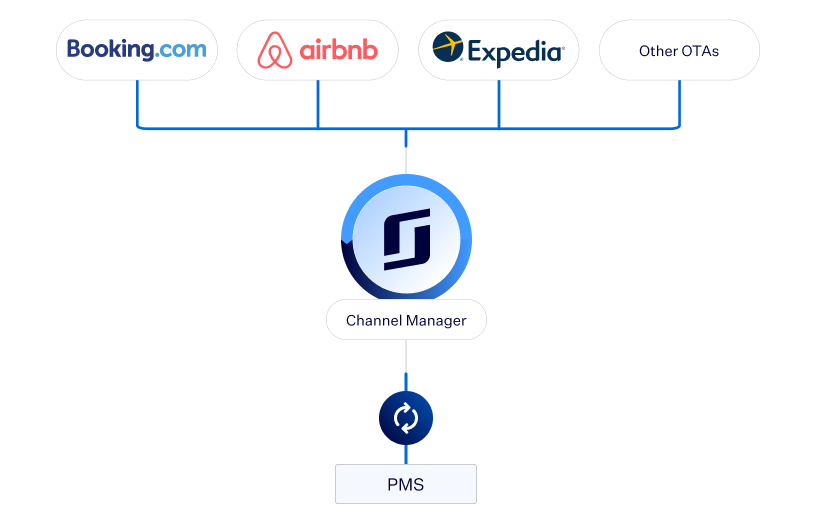
An OTA channel manager is a specialised subset of channel management technology designed to synchronise room inventory, rates and availability specifically across third-party booking sites. It acts as a central nervous system that ensures your property maintains maximum visibility without the risk of overbooking.
While a general channel manager might oversee your entire booking channel ecosystem – OTAs, your direct website, GDS – OTA-focused tools focus on the likes of Booking.com and Expedia, so the primary difference is in the breadth and depth of connectivity.
With SiteMinder capable of connecting to 450+ OTAs, manual updates become impossible. An OTA channel manager handles this at scale, across global giants and niche platforms, to ensure all guests are seeing accurate, real-time data. This narrow focus allows hoteliers to:
- Move beyond Booking.com and Expedia to experiment with niche OTAs that cater to specific (and often higher spending) demographics.
- Automatically adjust how your inventory is presented to align with the varied display standards of different booking platforms.
- Update rates across potentially hundreds of platforms simultaneously to ensure pricing remains consistent and optimised.
For a full overview of channel management across all distribution types, see our complete channel manager guide.
Table of contents
How does an OTA channel manager handle bookings across multiple OTAs?
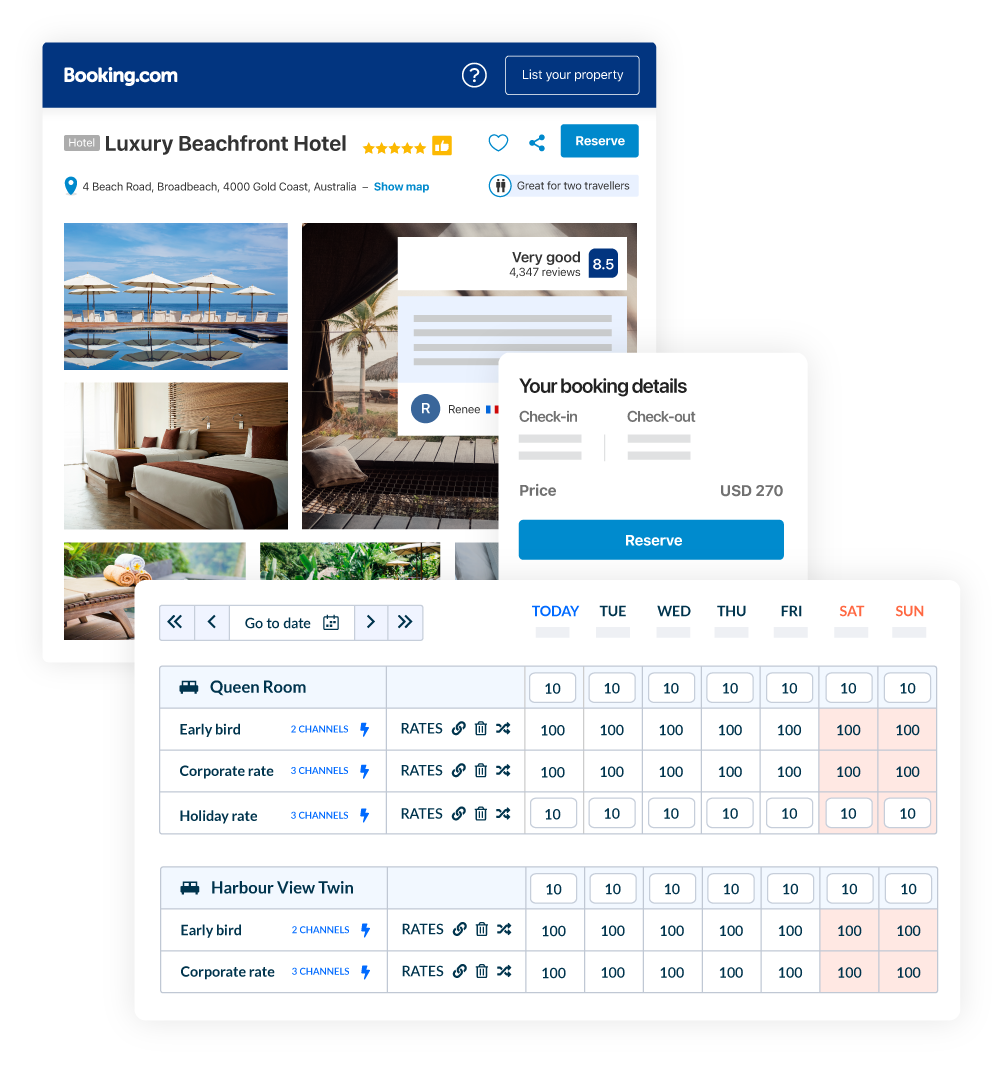
An OTA channel manager can synchronise specific room attributes and booking rules across hundreds of platforms simultaneously. It translates your property’s requirements and preferences into the unique technical formats required by each OTA.
OTA restrictions
Channel managers allow you to automate ‘stop sell’ commands and specific stay restrictions (like ‘minimum length of stay’) across all OTAs. During peak periods the tech can trigger a global stop sell once a certain threshold is reached, saving your final rooms for more profitable direct channels, and preventing double bookings.
OTA rate plans
OTA channel managers can map your rates to specific OTA room types. The channel manager ensures that ‘room only’ and ‘non-refundable’ plans are accurately assigned on each site. If you update a base rate in your PMS, the system updates it across every connected OTA.
OTA cancellation policies
When a guest cancels a booking on an OTA, the channel manager instantly re-releases that room across every other connected channel. This automation ensures your availability is always maximised.
OTA commission calculations
The system ensures that the rate pushed to the OTA accounts for whether the guest pays the property directly or the OTA collects payment upfront, so your PMS always receives accurate financial data, and your finance team never wastes time on reconciliation.
OTA bookings
If a booking fails to sync for whatever reason, the best channel managers will alert you immediately while holding the inventory locally to prevent a double-booking. Once the connection is restored, the system instantly re-syncs the data and restores full booking availability.
 Key takeaways
- Automated mapping translates internal rate plans into the specific formats required by OTAs.
- Real-time synchronisation instantly re-releases cancelled rooms to maximise availability.
- Global ‘stop sell’ commands can be used to set aside your last available rooms for more profitable direct booking channels.
How do OTA ranking algorithms interact with your channel manager?
OTA ranking algorithms are designed to reward proven, high-quality properties that provide the most reliable and attractive experience for the platform’s users. While the factors below are widely accepted as drivers of OTA visibility and placement, they don’t operate as a precise, fixed set of “ranking factors” in the search-engine sense. OTAs don’t publish official rulebooks the way Google does, and weightings vary by platform.
Rate parity compliance
OTAs prioritise properties with consistent pricing across the web – if they detect a price discrepancy that favours another site, you can be penalised. Using a channel manager to maintain rate parity gives the OTA the confidence that they’re offering a competitive deal, which can then boost your ranking.
Availability accuracy
Nothing damages an OTA’s brand more than a guest booking an unavailable room. Platforms therefore give properties that maintain 100% accurate availability a higher ranking. Channel managers present your hotel as a reliable partner by using real-time inventory updates to eliminate double-bookings.
Booking conversion rate
OTAs are in the bookings business. Your channel manager can increase OTA conversion rates by maintaining attractive rate plans – the more bookings you close, the more the OTA will promote your listing in order to make more sales.
Content completeness
Channel managers deal in more than just rates and dates. OTA algorithms check for full room descriptions, up-to-date amenity lists and high-quality imagery, so a quality channel manager will ensure that all your listings are fully populated and platform-approved.
Participation in OTA programs
Many OTAs offer programs that provide a ranking boost in exchange for discounts or commissions (e.g. Booking.com’s Genius). Your channel manager makes these programs viable by allowing you to selectively apply rates to specific channels.
Key takeaways
- Real-time inventory synchronisation establishes your hotel as a reliable partner and improves your ranking.
- Consistent rate parity gives OTAs the confidence to prioritise and promote your listings.
- Full content mapping and participation in OTA programs are signals of high-quality listings to search algorithms.
How do you set up an OTA channel manager for your hotel?
Setting up an OTA channel manager is a process of aligning your hotel inventory with the requirements of third-party booking sites. You need to ensure every rate, room and restriction is accurately translated, to maximise your visibility and revenue. Here’s how.
Step 1: Choosing a provider
Prioritise a technology provider with deep OTA connectivity; for instance, SiteMinder connects to 450+ channels, from global giants to niche operators. You want the ability to experiment with niche channels without adding to your admin. You also need to ensure the software can handle OTA-specific requirements for inventory and content.
Step 2: Preparing details
Gather the OTA logins for every channel you intend to link. Audit your content to meet OTA-specific requirements, including high-resolution image sizes and character limits for descriptions. Take time to align your policies too, from cancellation windows to deposit rules.
Step 3: PMS integration
Integrating your channel manager with your PMS is the most critical step of all. This two-way flow of data ensures that reservations and inventory updates move between your OTAs and your central dashboard in real-time. For a technical deep dive into this process, see our channel manager integration guide.
Step 4: Rate and room mapping
Room types often map differently across OTAs: a ‘Deluxe King’ on one site might be ‘Premium Room’ on another. Check how your rate plans translate on different platforms, then set any appropriate rules or restrictions on different channels.
Step 5: Test bookings
Before going live, perform test bookings to verify that rates are displaying accurately on every OTA and that availability is synced within seconds. Check that booking confirmations are delivered correctly and that cancellation policies are clearly visible to the guest.
What are common OTA channel management mistakes that cost hotels revenue?
With 26% of travellers now starting their hotel search on an OTA, overtaking Google and other search engines for the first time per SiteMinder’s Changing Traveller Report, the cost of poor OTA channel management has never been higher. Many hoteliers struggle to increase their OTA performance because they treat their channel manager as set-and-forget, rather than the dynamic distribution layer that it is. Success requires avoiding several high-impact pitfalls that can quietly erode revenue.
Here are a few of the most common errors, and how to avoid them.
- Rate parity violations across OTAs – Booking.com and Expedia use automated crawlers to detect rate parity issues. Even small discrepancies can trigger reduced visibility or status demotions. The channel manager must be the single source of truth for all OTA rates.
- Slow availability sync causing OTA overbookings – High-traffic OTAs can generate bookings within seconds of each other. If your channel manager doesn’t update in true real-time, you risk double-bookings on your busiest channels. OTAs penalise properties with frequent overbooking incidents.
- Over-distribution across low-performing OTAs – Connecting to 40 OTAs sounds good in theory, but if 80% of your OTA revenue comes from 5 channels, the administrative overhead of maintaining 5 low-performers isn’t worth it.
- Ignoring OTA promotional programmes – Booking.com Genius, Expedia Member Deals, and similar programmes boost ranking visibility in exchange for discounted rates to programme members. Not participating can mean missing potential visibility uplift where your competitors are enrolled.
- Manual rate overrides in OTA extranets – Manual overrides in OTA extranets break the single source of truth, often causing hidden disparities that parity tools then flag.
- Not optimising OTA content through the channel manager – Weak content lowers conversion, and most OTAs reward listings that convert well with more impressions, so poor content quietly pushes you down. Make sure photos, descriptions, and amenity tags are all current and accurate.
Key takeaways
- Centralise all updates in the channel manager to prevent issues, inconsistencies and penalties.
- Avoid over-distribution by focusing on high-performing channels rather than maintaining low-value, high-effort connections.
- Prioritise real-time availability to eliminate double-bookings and maintain high reliability with platforms.
What are the typical pricing models for OTA channel managers?
The cost of an OTA channel manager can vary significantly depending on the size of your property and the level of automation you require. Most will scale the cost according to the business, ensuring that small boutique hotels and large resorts can both access the technology at a fair price point.
- Subscription/fixed monthly fee: You pay a consistent flat rate regardless of booking volume, making this the most predictable model for monthly budgeting.
- Commission-based pricing: The provider takes a small percentage of every successful booking made through the channel manager, aligning costs with actual revenue.
- Pay-per-booking: Similar to commission, you pay a fixed dollar amount for each reservation processed – good for seasonal properties with fluctuating occupancy.
- Tiered pricing: Costs are based on the number of rooms at your property or the number of OTA channels you choose to connect.
- Set up fees: A one-time initial cost often charged to cover the setup and integration of the new tool.
What features should hotel owners look for in an OTA channel manager?
A high-performing OTA channel manager will act as a strategic revenue management partner, allowing you to manage your global visibility, availability and rates from a single, intuitive interface.
- Mapping: The ability to link a variety of room types and rate plans across hundreds of different OTAs to ensure your inventory is always represented accurately.
- Rate parity: Automated tools that monitor your prices across the web and alert you to discrepancies that could lead to OTA ranking penalties.
- Auto-updates: Real-time synchronisation that pushes availability and rate changes to all channels within seconds, eliminating the risk of double-bookings.
- Restrictions: The ability to set minimum stays, closed-to-arrival dates, or stop-sells channel by channel.
- Reporting: A central dashboard that provides clear data on which OTAs are performing best, so you can make informed decisions about your distribution mix.
Distribute smarter across 450+ OTAs
SiteMinder's channel manager keeps your rates, availability, and content synced in real time across Booking.com, Expedia, and 450+ other OTAs, eliminating the manual errors and parity issues that quietly erode revenue.
Learn more
How should hotels build their OTA channel mix?
Developing a modern distribution strategy isn’t about connecting to as many platforms as possible – it’s about precision and relevance. SiteMinder’s Hotel Booking Trends data shows that regional channels like Agoda climbed in 40% of Top 12 lists in 2025, while Trip.com debuted as a newcomer in major markets like Germany, Spain and the US. This highlights a shift toward more OTA diversity.
Global OTA anchors
Booking.com and Expedia Group remain non-negotiable for most hotels due to their massive reach, but there are other key OTA platforms too. In markets like North America (Expedia) and Europe (Booking.com), these giants dominate hotel searches. But using other platforms ensures you aren’t vulnerable to changes in a single provider’s algorithm or commission structure.
Regional OTA anchors
To capture high-value international guests, you must connect with regional specialists. Agoda is a vital link for APAC travellers, Trip.com is the primary gateway for Asian guests, and Despegar grants you access to the LATAM market.
The billboard effect
OTAs are as much marketing partners as booking sources. The ‘billboard effect’ describes the phenomenon where guests discover your property on a high-traffic OTA but then visit your website to book direct with you. SiteMinder’s Changing Traveller Report data confirms the pattern is strengthening: 18% of travellers who start their search on an OTA now ultimately book directly with the hotel, up 3.3 percentage points year-on-year. Quality OTA listings feed your direct booking funnel, as long as your own site offers a seamless experience and a clear reason to book direct.
Per-channel performance tracking
A channel manager’s reporting tools are essential for auditing your distribution mix. You should track revenue, ADR, cancellation rates and RevPAR for every connected OTA. Most importantly, calculate the effective acquisition cost by factoring in commissions and promotional programs. Move away from channels that consistently cost more than they deliver in profit.
Balancing OTA volume with direct strategy
The ultimate goal is a mix that maximises total revenue and profit, not just volume. SiteMinder data reveals that direct bookings averaged US$516 per booking in 2025, compared to US$312 for OTA bookings. This significant gap proves that while OTAs are necessary for occupancy, OTAs must complement, not cannibalise, direct bookings.
Key takeaways
- Supplement global anchors with regional specialists to capture high-value international traveller demographics.
- Use OTAs to drive traffic toward more profitable direct bookings.
- Audit channel performance and acquisition costs to ensure your distribution mix maximises profit.
Frequently asked questions about OTA channel managers
What is the difference between an OTA channel manager and an OTA extranet?
An OTA extranet is a management portal for a single booking site, like Booking.com. An OTA channel manager is a central hub that controls all your extranets simultaneously. Instead of logging into each individual platform to update rates and availability, the channel manager pushes a single update to every connected site.
What is channel mapping and why does it matter for OTAs?
Channel mapping links your internal PMS room types and rate plans to the structures of each OTA. It matters because it ensures data accuracy – without precise mapping, selling a ‘Deluxe Suite’ on one OTA may not see the same (but differently labelled) room removed from another OTA.
What is the ROI of using a channel manager for a 10-room hotel?
For small properties, ROI is driven by time savings and guest experience. Automating inventory can save 10-15 hours of manual admin a week, increased OTA visibility typically boosts overall occupancy, and it’s hard to put a figure on the immense value of entirely avoiding double bookings.