What is hotel forecasting?
Hotel forecasting uses historical performance, current booking data and market trends to predict a property’s future demand and revenue. It gives hoteliers the insight to set optimal room rates, allocate staff and resources efficiently, and prepare for both peak periods and unexpected disruptions before they hit.
As unpredictable as it can be at times, forecasting is still an important part of running a hotel and being able to make strategic revenue management decisions.
Whether you’re a seasoned hotelier or new to the industry, understanding the nuances of forecasting can be a game-changer for your business.
Table of contents
Why is hotel forecasting important?
Hotel forecasting is essential because it turns reactive decision-making into proactive strategy. Without a reliable forecast, pricing becomes guesswork, staffing is either over or under-resourced, and revenue opportunities are only visible in hindsight. A strong forecasting practice gives your property a consistent financial advantage, which helps you capture more revenue during high-demand windows and protect margins during quieter periods.
Understanding demand forecasting in the hotel industry
Demand forecasting is vital to predict guest numbers, optimising strategies for pricing, staffing, and marketing. Here’s a brief overview:
- Historical data. Analyse past bookings and guest trends to predict future demand.
- Market segments. Understand categories like business travellers or leisure guests to tailor strategies.
- Booking pace. Track the rate of reservations to gauge increasing or decreasing demand.
- Special events & holidays. Stay updated with local events and holidays that can spike demand.
- External factors. Consider influences like economic conditions or political events that might affect bookings.
- Technology. Use advanced tools for more accurate, automated forecasting.
Mastering demand forecasting helps you make informed decisions, ensuring profitability and guest satisfaction.
Precise forecasting, less work Make smarter decisions for your hotel with SiteMinder’s real-time data.
What is hotel forecasting software?
Hotel forecasting software analyses historical performance, current booking trends and external market data to predict future demand and occupancy levels. These tools are designed to generate insights that help hoteliers make informed decisions about room rates, staffing requirements and inventory management.
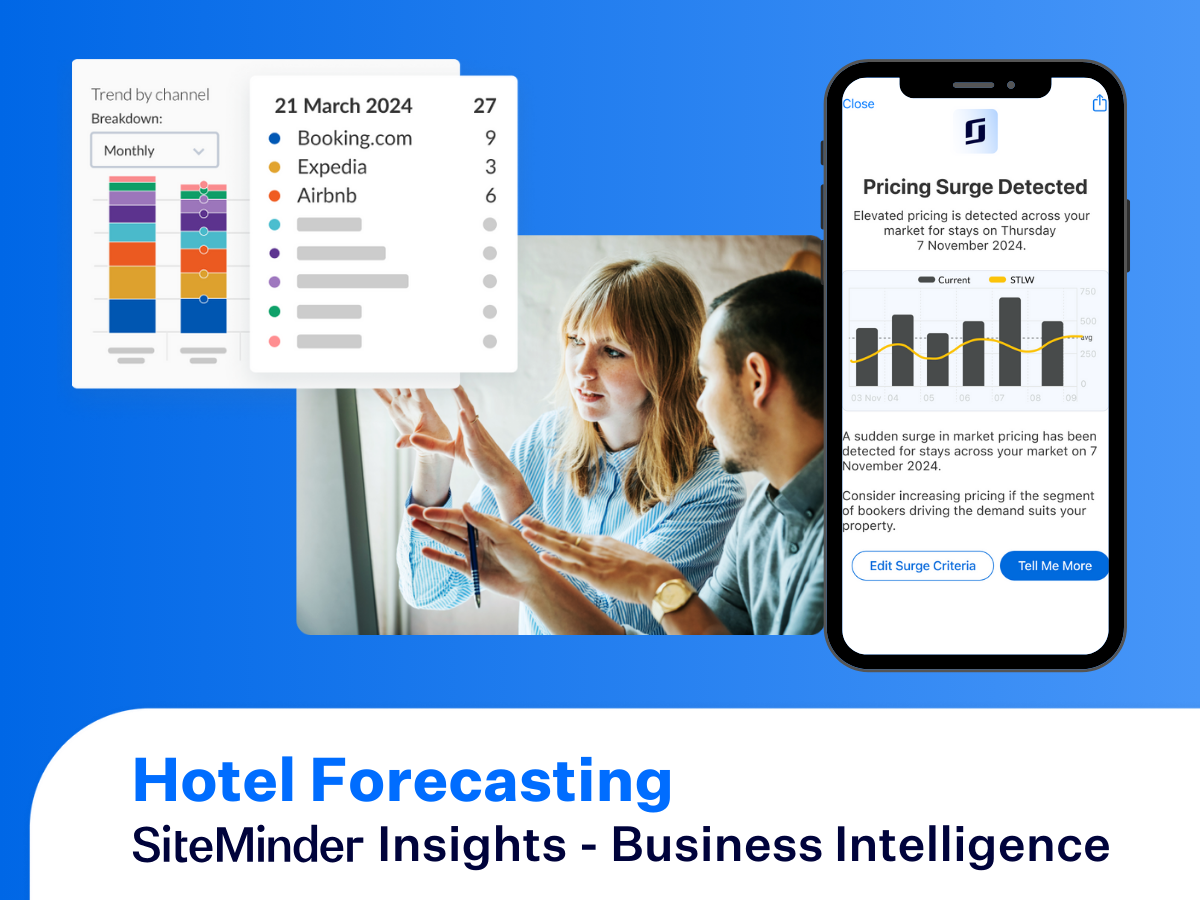
Hotel budgeting and forecasting software is often referred to as business intelligence software. It replaces manual spreadsheets and gut feel decisions with hard data converted into visual, easy-to-digest insights. Thousands of data points can be displayed within a single graph that tells you about year-on-year performance, competitor pricing or consumer trends, which allows you to map out the coming weeks and months with a surprisingly high degree of accuracy. As a result, a property can make informed decisions while also staying agile, adjusting pricing and inventory on the fly in response to evolving forecasts.
When a manager sees that a specific weekend in three months will see a 20% surge in demand due to a local festival, they can proactively raise the average daily rate (ADR) for that weekend and schedule extra housekeeping staff. Identifying a quiet mid-week period in advance, meanwhile, allows the marketing team to launch a targeted promotion to fill rooms that would otherwise be empty.
What are the core features of hotel forecasting software?
The core features of hotel forecasting software focus on accuracy, automation and accessibility. The aim is to generate clear, useful strategic insights, and to provide a single source of truth for managers, marketers and operations teams to base decisions on. Look for tools with:
- Real-time data integration: The tool should automatically pull the latest booking information from your PMS to ensure forecasts are always based on live data.
- Historical trend analysis: Compares current performance against previous years to identify seasonal patterns, potential long-term issues and growth trajectories.
- Market intelligence and competitor tracking: Monitors local market demand and competitor pricing to help you stay competitive in real time.
- Automated demand alerts: Notifies management of sudden spikes or expected lulls in booking demand so they can investigate and react quickly.
- What-if scenario planning: Allows users to simulate the impact of price changes or external events on future RevPAR and occupancy.
- Staffing and resource optimisation: Translates occupancy forecasts into recommended staff hours for housekeeping, front office, F&B teams, etc.
How does forecasting software work with your existing systems?
Forecasting software typically sits as a layer above your property management system (PMS) and channel manager, using a two-way sync to ingest booking data and push back pricing recommendations. These systems are most valuable when they’re fully integrated, to ensure that every real-world change results in instantly updated forecasts, no manual admin necessary.
Key takeaways
- Hotel forecasting software turns historical, live and market data into clear, actionable insights, replacing spreadsheet guesswork with faster, more confident decision-making.
- The most valuable features include real-time data integration, historical trend analysis, market intelligence, automated alerts and what-if scenario planning.
- Forecasting tools are most effective when integrated with your PMS and channel manager, so booking changes automatically flow into your forecasts and pricing decisions.
How do you read a revenue forecast report for hotels?
Reading hotel revenue forecast reports is a process of comparing current business performance against historical trends to identify revenue issues and opportunities. The primary focus should be on the relationship between your forecasted occupancy, average daily rate (ADR) and RevPAR to check that your pricing strategy is effectively capturing projected demand. Smart tools use data visualisations to make these relationships clear.
Your hotel revenue report offers a detailed look into the monetary health of your hotel, including its current performance, its opportunities, and its challenges.
Whether you’ve been in the hotel business for decades or are charting your first course, decoding this report is essential for steering your establishment towards growth and profitability.
Understand key metrics
Average Daily Rate (ADR), Revenue Per Available Room (RevPAR), and Total Revenue are essential metrics included in comprehensive revenue forecast reports. Knowing what each metric represents will provide a clearer picture of your hotel’s performance and areas of improvement.
Analyse historical data
Historical data serves as a foundation for forecasting. By examining past revenue trends, seasonal fluctuations, and guest preferences, you can predict future demand more accurately. This analysis also helps in identifying patterns and anomalies that might affect future revenue.
Segment market
Market segmentation involves categorising your target audience based on various criteria like demographics, booking channels, or purpose of visit. By understanding which segments bring in the most revenue, you can tailor your marketing and pricing strategies to attract and retain these valuable customers.
Demand forecast
Anticipating future demand is crucial for setting room rates and promotional offers. By analysing booking trends, event calendars, and market conditions, you can estimate the number of guests expected during a particular period, allowing for better inventory and pricing management.
Occupancy rate
The occupancy rate indicates the percentage of rooms occupied over a specific period. A higher occupancy rate often signifies robust demand, while a lower rate might indicate the need for promotional activities or rate adjustments. Monitoring this rate regularly can guide your revenue management decisions.
External factors and trends
Beyond internal data, it’s essential to be aware of external factors that might influence your hotel’s revenue. In your forecast report, this may include local and global economic conditions, local events, competitor activities, and emerging travel trends. Staying updated with these factors ensures that your revenue forecast is both comprehensive and accurate.
Key takeaway
Reading a hotel revenue forecast report means starting with core metrics like occupancy, ADR, and RevPAR, then layering in historical trends, segment performance, demand signals, and external market factors so pricing and inventory decisions reflect the full revenue picture, not just one number.
What are the best hotel forecasting methods to use?
The most effective hotel forecasting methods combine historical performance data with market segmentation and competitor analysis. A basic model uses past occupancy, ADR and revenue to project future months, while advanced approaches layer in segment-level data, event-driven demand shifts and real-time competitor pricing to refine accuracy.
The simplest starting point is to use purely historical data to predict future outcomes. For example, you could single out a particular month and look at:
- How many room nights were sold
- Your occupancy rate
- Your average daily rate
- Your total revenue
- Average length of stay
- Booking lead times
Based on this you could predict similar numbers for the same month the next year, and strategise on how to improve your performance and boost profit.
A more advanced hotel forecasting model that your hotel can use is to also look at data based on segmentation in addition to the basic metrics above.
This means taking into consideration things like group bookings or demand driven by abnormal circumstances.
For example, if a company booked a corporate trip as a once-off, you know you can’t rely on that larger-than-normal influx of occupancy or revenue the next year. So you would need to look at ways you could fill the gap in room nights or earn more revenue from the other predicted bookings.
Going further, to completely flesh out your revenue management forecasting, you should also take competitor pricing and overall market performance into account. This will allow you more clarity and flexibility when it comes to setting your rates.
For instance, you might want to set seasonal prices, target new demographics, implement new promotions, or market your property on a comparative basis to beat your competitors.

Jon Murphy,
Consultant Revenue Director
Kaleidoscope Collection
How do you choose a hotel forecasting software?
The right hotel forecasting software will be capable of crunching complex data, and will then translate this analysis into easy to digest morsels within an intuitive interface that doesn’t require any data science skill or experience. You’ll want access to real-time, actionable insights that allow you to adjust your revenue strategy instantly.
Integrates with PMS
Seamless integration with your property management system (PMS) is the single most critical requirement of the right tool. The hotel forecasting software must be able to talk seamlessly with your PMS, as this two-way sync allows you to automate endless admin and generate difference-making insights in real time.
Connects with channel manager
Likewise, linking the forecasting tool to your channel manager ensures that spikes in demand instantly translate to increased rates across all your booking channels, from OTAs to your direct booking website. As a result, your room rates will always be set at the maximum that the market is willing to pay at any given moment.
Balances automation and manual control
The best software handles the heavy lifting of data processing while still allowing you to manually override decisions based on your knowledge and expertise. You need the flexibility to adjust for one-off events – a disruptive local construction project, a severe weather event – that algorithms using historical data struggle to account for.
Supports budgeting
Effective forecasting tools help you build and track your annual budget by comparing actual earnings and expenses against financial targets. This feature makes it easy to report to stakeholders, by showing you exactly where you are over-performing or falling behind, and allowing you to tweak your long-term plan.
Transparent data
Avoid ‘black box’ systems that provide numbers without explaining their logic or source. Be very cautious with generative AI, as these systems can hallucinate (read: lie), pulling numbers from thin air and quoting them with total confidence. Ensure you can see the ‘why’ behind every recommendation your tool makes.
Strong onboarding and support
Advanced software is only valuable if your team knows how to use it, so look for providers that offer comprehensive training and support. A strong onboarding process ensures you are set up for success from day one, while ongoing support helps you to get maximum ROI from your investment.
Fits your property size
A small B&B has very different needs to a 500-room resort, which has different needs again to a multi-site hotel chain. Ensure your chosen tool has the features and scalability that your business demands, so you don’t pay for unnecessary features, and the software will be able to keep pace with your growth.
Key takeaways
- Start with integration: if the tool doesn’t sync seamlessly with your PMS and channel manager, forecasts become slower, more manual and less actionable.
- Choose software that balances automation with manual control, so you can benefit from data-driven recommendations without losing the flexibility to respond to local conditions.
- Look for a platform that is transparent, supports budgeting, and fits your property size, along with onboarding and support to help your team gain value quickly.
How does hotel forecasting software differ from revenue management software?
Hotel demand forecasting software focuses specifically on predicting future demand and occupancy levels based on historical and contemporary data. Revenue management software (RMS), meanwhile, is a broader suite that uses those forecasts to automatically execute pricing strategies, manage inventory distribution and maximise total RevPAR.
In other words, forecasting software makes the predictions, revenue management software acts on those predictions. Many modern RMS platforms include forecasting, but standalone forecasting tools are still popular.
What are the benefits of using hotel forecasting software instead of spreadsheets?
Hotel forecasting software eliminates the bulk of manual data entry, which is slow, error-prone, and offers very limited insights. It allows you to trade complex and confusing spreadsheets for automated, difference-making insights. You can then react to market shifts instantly rather than waiting for a manual update.
The cost of relying on disconnected, manual workflows is well documented. Hospitality businesses waste an average of 286 hours per year switching between disconnected systems and lose 13% of operational costs as a result. This means most properties still leave significant time and revenue on the table.
Spreadsheets are static and struggle to process the massive volume of variables such as market demand, competitor pricing, local events, and even weather patterns; all of which can affect occupancy and room rate decisions. Modern algorithms, however, handle this endless data with ease, presenting clear, visual trends that are much easier for a hotel to interpret and act upon.
What are best practices for hotel revenue forecasting?
Effective hotel revenue forecasting requires combining key performance metrics such as occupancy, room nights and average daily rate, with regular reviews that allow you to adjust your strategy as new data emerges. The goal is not a single static projection but an evolving forecast that reflects real-time market conditions, helping you react to changes, optimise occupancy and maximise revenue.
When compiling your data and establishing your hotel forecasts, it’s crucial that everything is as accurate as possible and that all data points have been accounted for.
Remember the following:
- Draw on past performance data and historical market trends
- Factor in current hotel data such as reservations, confirmed upcoming promotions or marketing campaigns, and website traffic and conversions
- Monitor current market trends such as increases or declines in arrivals to your destination or changes from particular source markets
- Ensure good quality data is collected, including specific channel performance, travel types (business or leisure for example), guest demographics, and drilled down metrics like RevPAR
- Always take events, holidays, and global conditions into account
- Review your performance and forecasts regularly in conjunction so you can make quick and effective decisions
- Consider competitor performance as part of your calculations
- Compare your share of new bookings vs repeat bookings to help define your strategy
- Work hard to reduce data errors such as incorrect segmentation, duplicate bookings, pending reservations, overbookings, or incorrect rate mapping or reservation dates
Frequently asked questions on hotel forecasting
What is a hotel availability forecast?
A hotel availability forecast is a predictive tool used by hoteliers to estimate the number of rooms that will be available for sale over a specific period. This forecast takes into account the total number of rooms in the hotel and subtracts the number of rooms that are expected to be occupied. The result gives hotel managers an idea of how many rooms they can still sell, allowing them to make informed decisions about pricing, promotions, and distribution.
What is the best hotel forecasting software?
The best software can vary depending on property type and size, but for medium to large hotel businesses and chains, SiteMinder’s forecasting tools – Business Intelligence and Dynamic Revenue Plus – are widely recognised as market leaders, due to their seamless integration with distribution channels.
How does accurate forecasting improve a hotel’s bottom line?
Accurate forecasting boosts profitability by allowing you to implement dynamic pricing. It helps you to maximise your rates during high-demand peaks, and identify potential troughs early so you can craft strategic promotions that fill empty rooms. It ensures you don’t undersell rooms when there are indications that guests are willing to pay a premium.
How can a hotel general manager use forecasting reports to optimise staffing?
General managers can use occupancy forecasts to ensure an appropriate amount of front desk, housekeeping and F&B staff are scheduled to work based on expected guest numbers. This avoids costly overstaffing during quiet times, and it stops the guest experience from being negatively impacted by understaffing during busy times.