What is hotel dynamic pricing?
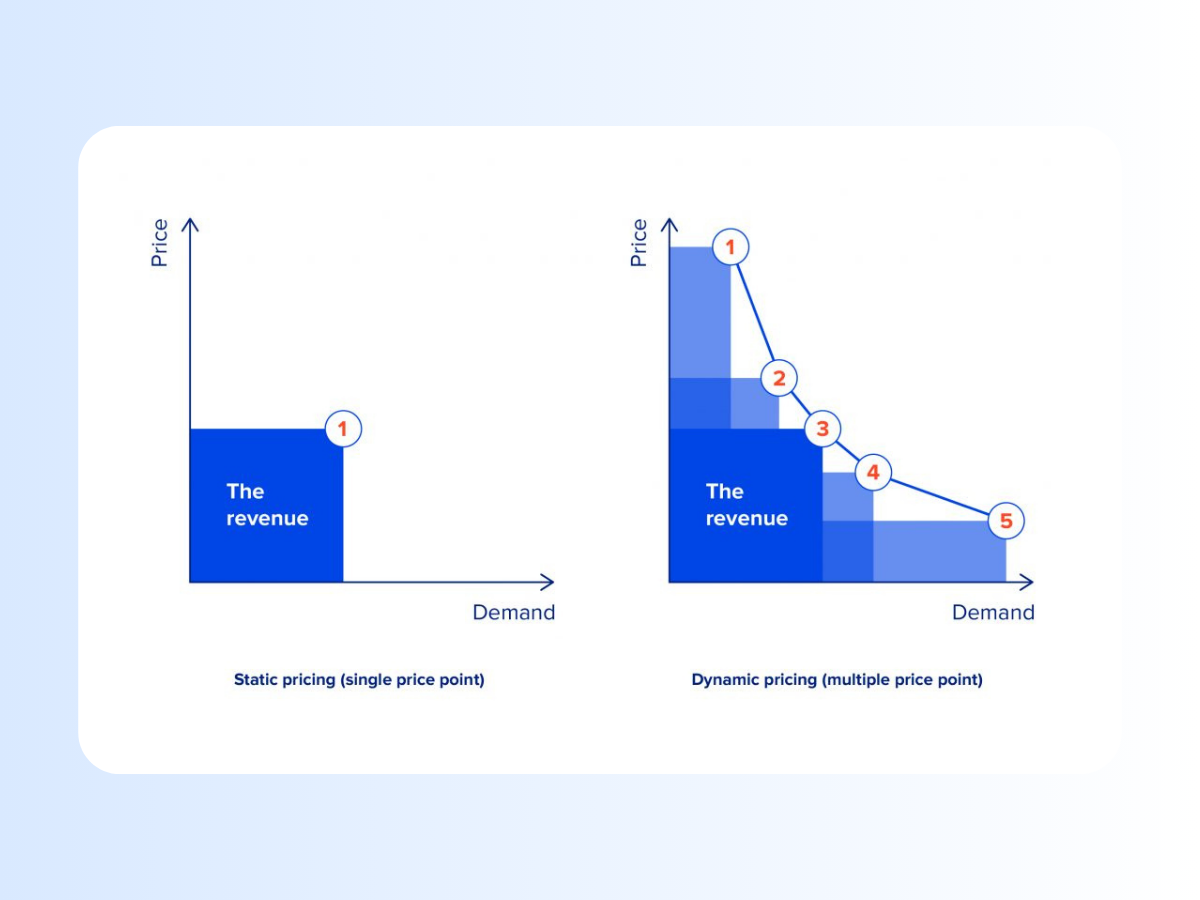
Dynamic pricing is a pricing strategy for hotels that adjusts room rates in real time based on current market conditions, including supply, demand, competitor behaviour, and local events. Rather than setting fixed seasonal rates, dynamic pricing allows hotels to raise or lower prices throughout the day to maximise both occupancy and revenue from every available room.
For example, in the morning you may have lower rates because your occupancy is low and demand is not strong. However, by evening your supply may have reduced and demand could be growing. Naturally, you want to increase rates at this point.
This blog will give you a full guide to hotel dynamic pricing, how it works, and the best ways to implement it at your business.
Table of contents
What is the difference between static and dynamic rates for hotels?
The difference between static and dynamic rates for hotels is that one is relatively rigid and the other is based on real-time market data.
Static rates are a traditional way of pricing hotel rooms which usually includes a standard weekday rate, elevated weekend rate, and increases during peak seasons.
A static rate would be unaffected by external factors such as fluctuations in traveller demand or changes in competitor behaviour. Dynamic rates, on the other hand, take all that information into account to give hoteliers the information they need to maximise revenue at all times. A dynamic rate is one that could change by the day, or even the hour, depending on current market conditions.
Today, dynamic rates are much more useful for running a profitable hotel business than static rates.
Exploring a comprehensive hotel revenue management strategy shows how real-time rate adjustments help hoteliers capture maximum revenue in any market condition.
Better pricing, more revenue, less work
What if you could tap into real-time supply and demand data to make instantly effective pricing decisions? Our smart hotel platform helps you do exactly that.
Learn more
Why is dynamic pricing important for a hotel?
Dynamic pricing enables a hotel to optimise occupancy and maximise profit. It tracks market conditions in real-time and sets room rates based on variables like demand and competitor pricing. As a result, it prevents too many rooms from staying unoccupied and rooms being sold for less than their maximum potential value.
Here are some of the advantages of using dynamic pricing at your hotel:
- Boost occupancy – When demand drops, you can drop your rate to increase the chances of a booking.
- Maximise profit – When demand is high and supply is low, you can sell remaining inventory at higher rates.
- Improve forecasting – Compare historical data with current market conditions to get an idea of what you can set your rates at in the future.
- Beat your competition – Acting on market fluctuations will allow you to get ahead of your competitors, who may not be as switched on.
- Understand traveller booking behaviour – See how customers respond to changing market conditions and prices to get insight into how to better target them in the future.
However, dynamic pricing isn’t always perfect. As with any strategy, there are potential drawbacks that hoteliers need to be aware of.
Some of the risks associated with dynamic pricing include:
- Customer confusion – If prices are changing from morning to night, some travellers may start to question the price integrity of a hotel.
- Stakeholder management – While revenue managers will certainly be looking for any chance to maximise revenue, marketers and those in charge of brand may not be as comfortable with regular fluctuations.
- Technology barriers – To get dynamic pricing right, multiple systems usually have to be used and integrate seamlessly to ensure data is accurate and up-to-date.
- Brand perception – Does dropping your prices too low devalue your brand, and does pushing them too high alienate some of your loyal guests?
- Long-term success – If travel agents or travel companies find it hard to budget and book with you because of variable prices, will they take you out of consideration in the future?
Key takeaways
- Dynamic pricing tracks real-time market conditions to set room rates in a way that optimises occupancy and maximises profit.
- Adjusting rates based on demand allows hotels to stay competitive and outmanoeuvre slower rivals.
- Frequent price fluctuations require careful management if you are to maintain brand integrity and guest loyalty.
How does dynamic pricing work in the hotel industry?
Dynamic pricing in the hotel industry works by adjusting room rates based directly on real-time market conditions such as special events, competitor behaviour, weather, customer behaviour, and general supply and demand.
The hotel revenue manager will track what’s happening in the market throughout the day and week to pick up on any noticeable changes. This will allow them to capitalise on opportunities to boost occupancy and/or maximise revenue.
Here’s how this works in practice:
Dynamic pricing example for a hotel
A good dynamic pricing example for a hotel is when something out of the ordinary happens that enables hoteliers to respond and adjust their rates.
For instance, let’s say your hotel’s standard room rate is $210 per night when not in peak season. On weekends, it’s $220 and in peak season it’s $250.
Then, Taylor Swift announces a tour and your city is on the list of destinations she’ll be playing in. The dates for her shows fall on what would normally be a ‘standard’ Friday and Saturday night.
Tickets go on sale and excited fans snap up their tickets, with their attention quickly turning to accommodation for a night or even the whole weekend.
If you kept your rates static, your hotel would likely be the best deal around and you’d sell out your entire inventory for that weekend – potentially missing out on a lot of revenue.
However, if you react to the breaking news of the tour announcement by increasing your rates and even creating new packages, you’ll earn more from every booking than you normally would have.
Then, when supply dips lower as the date draws nearer and more hotels are selling out, you can raise your rates again because demand is still high for those who are booking with a smaller lead time.
Depending on your strategy, you might also try to entice some guests to increase their length of stay to take in more nights than just the dates of the show.
For instance, you could lower your rates back down for Sunday or Monday when most people might be flying out and airports would be busy and expensive. This could help maintain some of your occupancy and keep the revenue flowing in for a little longer.
Hotel dynamic pricing algorithm
A hotel dynamic pricing algorithm can be used to focus on particular areas of the market and what responses should be made.
It’s a set of rules to follow to achieve a set desired outcome. For example, an algorithm might be created to watch competitor occupancy and room rates to price match, undersell to win occupancy, or oversell to maximise revenue when they are sold out.
Often, algorithms are run by machines and there are dynamic pricing systems available to hotels. But algorithms can also be done manually. For instance, a recipe is also an algorithm.
Most hotels will have some kind of software to help them track real-time market conditions, before they decide how and when to adjust rates. Others ways use a completely automated approach, whereby the system will adjust the rates for them based on preset parameters and rules.
Key takeaways
- Dynamic pricing works by adjusting room rates in real-time based on supply, demand, and local events.
- Hotels can capitalise on high-demand periods, like major concerts, by increasing rates as room availability decreases.
- Dynamic pricing tools with smart algorithms allow hotels to automate price changes based on specific rules, such as matching or underselling competitors.
Optimise your pricing and maximise room revenue
SiteMinder connects with leading revenue management systems to automatically update your optimised rates across all distribution channels in real-time, maximizing the yield of every room through intelligent pricing.
Learn More
How does demand forecasting drive dynamic pricing?
Demand forecasting provides the data foundation for dynamic pricing by predicting the volume of future bookings, and what guests will be willing to pay for each. By analysing historical bookings, market trends and upcoming events, forecasting allows you to automatically adjust room rates before a shift in demand occurs, which in turn ensures you capture the maximum yield possible.
Accurate demand forecasting translates raw data into actionable pricing insights. Rather than reacting after a few rooms have already sold at a lower rate, it tracks booking pace and unconstrained demand to identify high-volume booking windows 30, 60, or even 90 days in advance.
When an upcoming surge in demand is forecast – following the announcement of a local festival, for example – dynamic pricing engines follow preset rules to automatically raise rates and/or apply length-of-stay restrictions on your rooms. Conversely, when forecasting models show a slowdown in booking velocity, dynamic pricing algorithms can drop rates or trigger targeted packages to stimulate sales.
For a deeper look at building demand calendars and projecting room volume, explore our complete guide to hotel forecasting.
Key takeaways
- Forecasting is what makes dynamic pricing proactive rather than reactive. You move rates before demand shifts, not after rooms have already sold cheap.
- Booking pace and unconstrained demand are the signals worth pricing off, 30 to 90 days out, on both peaks and troughs.
- The strategy is only as good as the forecast. Thin or inaccurate demand data caps how aggressively you can price.
What is competitive rate shopping and how often should you do it?
Competitive rate shopping is the continuous monitoring of competitor room prices, inventory and promotions across the internet. Hoteliers should perform rate shopping daily, ideally using automated business intelligence tools that can detect market shifts instantly and adjust prices accordingly.
Rate shopping gives hotels the pricing insights they need to stay competitive and outposition their competitors. By tracking a relevant set of competitors across direct websites, online travel agencies (OTAs) and metasearch platforms, revenue managers can identify local pricing trends, spot unexpected spikes in demand, and react before competitors undercut you to win bookings.
While manual rate checks are time-consuming and prone to human error, automated rate shopping software continuously gathers and crunches pricing data accurately. Monitoring these shifts daily allows hotels to evaluate their Average Rate Index (ARI), capitalise on competitor sell-outs by raising rates on remaining rooms, and ensure their property is never inadvertently over- or under-priced by a local rival.
Key takeaways
- Rate shopping only pays off at the cadence the market moves e.g., daily, and automated. Otherwise, you’re reacting to yesterday’s prices.
- The real value is timing: spotting a competitor sell-out or demand spike early lets you lift rates before others do.
- Tracking your Average Rate Index keeps you from drifting over, or under-priced against the comp set without noticing.
What is rate fencing and how does it protect your margin?
Rate fencing protects hotel profit margins by establishing specific conditions or restrictions that guests must meet in order to qualify for lower room rates. Rate fences separate price-sensitive travellers from those willing to pay a premium, allowing hotels to implement dynamic pricing without devaluing their brand.
Rate fencing is used in concert with dynamic pricing to ensure every guest segment is served the maximum price they are willing to pay. Traditional rate fences include non-refundable cancellation policies, advance purchase requirements, minimum length-of-stay (MLOS) rules, or exclusive tiers for loyalty members and corporate accounts.
By applying these targeted restrictions, hotels can win price-focused travellers during off-peak periods without offering the same discounted rates to the high-intent bookers willing to pay full price.
To explore how rate fences fit within broader hotel room rate setting, check out our comprehensive guide to hotel pricing strategies.
Key takeaways
- Ratee fencing lets you discount without devaluing. You drop the price for a segment, not for everyone.
- Non-refundable terms, advance-purchase rules, and minimum stays are the levers that keep high-intent bookers paying full rate.
- It’s the guardrail that makes aggressive dynamic pricing safe for the brand, not just the margin.
What are the best ways to use dynamic hotel pricing?
Dynamic pricing by the numbers:
- Industry benchmarks suggest that a strong dynamic pricing strategy can increase overall hotel revenue by 10-25% versus a static pricing model.
- SiteMinder’s booking data shows day-of-week pricing is now most dynamic in Ireland, the US and Australia, where the gap between the priciest and cheapest average nights hits US$87, US$63 and US$51 — and Friday is the most expensive night in 90% of markets.
- 58% of travellers are now trading up to Superior or luxury rooms, leaving room to lift rates on higher-value inventory without dampening demand.
There are a few ways to put dynamic pricing into action and also some different ways to analyse performance and make adjustments. Here are the five best ways to apply dynamic pricing at your hotel:
1. Tracking occupancy
Keeping an eye on your own occupancy and comparing it alongside your competitors is a great way to price your hotel to your advantage. If you notice your closest competitor sell out, it means you then have a monopoly on supply. This allows you to sell your remaining inventory at a higher rate.
Similarly, if your occupancy is low and you could lower your rate to ensure it is less than what your competitor is charging. This will help your hotel drive more demand than other properties in the area.
2. Responding to abnormal market conditions
On some days, there might be a high number of flight cancellations due to weather or other factors. It pays to take notice of what’s happening around you in real-time so you can quickly capitalise on opportunities to capture extra bookings or maximise profit.
3. Creating ‘peaks’ outside of peak season
Events like the Taylor Swift example allow you to forecast stronger periods of performance and plan ahead throughout the year, instead of relying solely on your traditional peak season to cash in.
4. Learn guest segment patterns
If you notice particular booking patterns such as more last-minute reservations at a certain time of year, or a particular audience segment opting for packages, you can start to forecast more accurately and strategise for greater success.
5. Experiment with room type preferences
In summer, people might be more concerned about getting a room with a view than they are in winter, for instance. Or, you might notice the rooms close to the bar and restaurant are much more popular on weekends, while rooms closer to the gym or work spaces are more popular during weekdays.
Key takeaways
- Monitoring when competitors are sold out allows you to capitalise on a supply monopoly by raising your remaining rates.
- Tracking real-time factors like flight cancellations or local events can create revenue peaks outside of traditional high seasons.

Annie Hong,
Revenue and Reservations Manager
The RuMa Hotel and Residences
What are the best dynamic pricing practices for hotel groups and chains?
Hotel groups and chains often struggle with efficiency – with multiple properties and a lot of rooms and room types to sell, getting new offers created and out to market quickly is important.
But it’s hard to take a dynamic approach to this, because by the time everything has been done the market has changed again.
Here are a few best practices that will help:
Know the market intimately
Multi-site hotel businesses must analyse historical demand, local events and seasonal booking trends across every region they operate in. Understanding peak, shoulder and low seasons, and how they differ from region to region, hotel to hotel, allows revenue teams to establish more effective pricing rules that capture demand without underpricing rooms.
Understand the customer fully
Analysing guest booking behaviours, lead times and channel preferences enables multi-property brands to anticipate shifts in demand. Breaking down target customer segments helps a brand deliver tailored packages and rates that align with guest expectations.
Monitor trends constantly
Continuous, real-time tracking of shifts in the market, both in terms of what guests are willing to pay and what competitors are charging, helps hotel groups to avoid leaving revenue on the table. If you identify a surge in demand, you can adjust rates and minimum stay rules to fully capitalise on the opportunity, and use the subsequent insights to inform pricing across all your hotels. As a result you can consistently elevate occupancy, optimise hotel ADR and drive overall hotel RevPAR.
Beware the pitfalls
Rapid automated price shifts carry branding and operational risks if they aren’t managed carefully. Dramatic fluctuations without clear reasoning or rate fences can confuse guests, alienate loyal customers and see you take a reputational hit. Multi-property brands need to maintain clear pricing guardrails that ensure they avoid wild rate swings.
Use the right software
Scaling dynamic pricing across every hotel in a chain requires enterprise-ready technology that centralises data and automates rate distribution. A centralised and capable hotel platform allows revenue managers to push out synchronised price updates across hundreds of channels and properties in real time.
How does booking lead time shape your hotel pricing?
Booking lead time – the time between a booking being made and the guest arriving – dictates how aggressively hoteliers should adjust the rates of the remaining rooms. If a lot of reservations are coming in for dates that are months away, this suggests a peak demand period that should be capitalised upon. By analysing lead-time windows, you can use early bookers to secure baseline volumes, then maximise your margins as rooms become more scarce.
The 90-day window: capturing early planners
Guests booking three months or more in advance are typically price-conscious planners, corporate travellers or large groups. During this early booking phase hotels can use lower pricing or advance-purchase rate fences to build a foundational level of occupancy – early volume that mitigates risk for the upcoming season.
The 30-day window: where demand signals sharpen
As dates get to a month out, booking pace typically accelerates and demand signals become a little clearer. Hotels should monitor booking trends against historical data to check unconstrained demand. If the pace of new reservations is outpacing prior years or current projections, your dynamic pricing engine can automatically raise rates or implement minimum length-of-stay restrictions to fully capitalise on the higher demand.
The 7-day window: pricing for urgency and last-minute demand
The final week before arrival is typically the most difficult to price, as some travellers will be willing to pay a premium in a booking emergency, while others will only choose your hotel, or indeed to travel at all, if they can get a great deal. Your rates will depend on remaining inventory levels at your property, and the pricing and availability of your direct competitors. You’ll typically either push rates to their maximum ceiling to capitalise on urgent demand or selectively drop rates to get what you can for otherwise empty rooms.
Key takeaways
- Each lead-time window is a different job: build base volume early, defend yield in the middle, read remaining inventory late.
- Booking pace against your own history is the trigger. Outpacing prior years 30 days out is your cue to raise rates or add minimum stays.
- The final week is a judgement call, not a formula: push to the ceiling on urgent demand, discount selectively only to clear rooms that would otherwise sit empty.
How is AI changing hotel dynamic pricing?
AI is changing hotel dynamic pricing by replacing static, rules-based rate adjustments with self-learning systems that process millions of data points in real time. These engines continuously learn from historical booking patterns and current market signals, allowing hotels to identify and capitalise on micro-trends in demand that manual methods would miss.
- Hotels using AI-driven revenue management report an average 17% increase in total revenue compared to those using traditional methods.
- AI-driven forecasting is approximately 20% more accurate than legacy models, leading to better staffing and resource allocation.
- The combination of faster reaction time, continuous learning, and data-driven accuracy gives AI-equipped hotels a compounding revenue advantage over those still pricing manually.
What does this look like in practice? Consider a sudden surge scenario. A hotel in a coastal town has just received a weather forecast that says the predicted weekend rain will no longer arrive, and clear skies are coming. A major airline has also just announced a flash sale for flights to the nearest airport.
A manual revenue manager might not notice these external shifts until they see a spike in bookings on Wednesday or Thursday, by which time several rooms have already been sold at a low rate. AI, meanwhile, detects both the updated weather forecast and the surge in flight searches immediately. It instantly raises room rates by 15%, and continues to nudge prices north as competitors begin to sell out. The result: the hotel is fully booked for the weekend, and at a significantly higher profit margin.
Key takeaways
- AI pricing engines continuously learn from booking data and market signals, becoming more accurate as they process more information.
- By updating rates hundreds of times per day, AI captures micro-trends in demand that manual methods would miss entirely.
- The speed gap between AI and manual pricing is most visible during sudden demand shifts. Properties that react first capture the highest margins before competitors adjust.
How can hotels prepare for AI dynamic hotel pricing?
AI dynamic pricing demands a switch in thinking. Hotels need to transition from a manual, reactive approach to rate-setting, to a proactive, data-driven strategy. The foundation of this effort is your technology stack – specifically the property management system (PMS) and channel manager – which must be able to support the flow of data that AI requires.
Begin with an audit of how often rates are currently updated – if you’re only adjusting prices a few times a week, you’re probably leaving a lot of revenue on the table. Research both AI-powered pricing tools and the complementary software that surrounds them: a robust, well-connected platform ensures that when the AI identifies a shift in demand, a new rate is pushed to every booking channel in milliseconds.
For hotel groups, the right AI pricing tool also needs to centralise data across multiple locations while allowing for property-level nuance. A centralised intelligence engine like SiteMinder iQ integrates with the broader SiteMinder ecosystem, letting you manage bulk rate changes and complex multi-property campaigns from a single interface.
With your technical foundation in place, begin with a test phase rather than a full-scale immediate rollout. Apply AI dynamic pricing to a small set of rooms to measure performance against a control group using traditional pricing methods. Once you gain confidence in the AI, roll it out across your property.
Frequently asked questions about hotel dynamic pricing
Will AI replace hotel revenue managers?
AI won’t replace hotel revenue managers, but it will be a collaborative partner that helps them to perform better. While the system handles thousands of pricing micro-adjustments, the revenue manager is responsible for high-level strategic positioning, steering it in the right direction.
This allows the AI system to learn from the human operator’s knowledge and expertise, gradually earning more autonomy as it aligns with the hotel’s long-term goals. By offloading the low-value busywork to AI, revenue managers are freed to focus on creative strategy, like designing unique guest packages and aligning pricing strategy with the hotel brand.
Why should a hotel use AI for dynamic pricing instead of manual pricing?
AI processes millions of data points (competitor rates, flight arrivals, weather shifts) in real time, powering hundreds of informed price updates per day. Humans simply can’t process or act on this information quickly or accurately. This speed ensures your property captures sudden demand spikes and prevents rooms being sold too cheaply.
What should hotels look for in an AI dynamic pricing engine?
The most important factor is how well the pricing engine integrates with your existing technology stack. An AI tool that operates in isolation, and is disconnected from your channel manager, PMS, and booking engine, creates data silos that limit its effectiveness. Look for a solution that sits within a broader hotel platform, so that when the AI identifies a demand shift, the optimised rate is pushed to every distribution channel instantly.
SiteMinder’s ecosystem is designed to work this way, with AI-powered pricing intelligence built into the same platform that manages your channels, direct bookings, and market data.
Can AI dynamic pricing work across multiple hotel properties?
Yes, modern AI systems are designed to manage multi-property portfolios. They centralise data into a single dashboard while accounting for the unique market conditions of each property. Hotel groups can therefore maintain brand-wide pricing strategies while the AI automates local adjustments based on demand and competitor behaviour.
What guardrails should hotels set when using AI dynamic pricing?
Hotels should establish floor and ceiling price limits to ensure the AI never drops rates so low they devalue the brand, or raises them so high they alienate loyal guests. You should also set alert parameters for abnormal recommendations: if the system suggests a drastic price shift that seems out of the ordinary, it should be manually reviewed before going live.
Does changing your room rates frequently affect your hotel’s OTA ranking?
Frequent rate adjustments generally enhance your OTA visibility, as long as you maintain rate parity and your price changes align with real-time market demand. Online travel agencies (OTAs) tend to prioritise properties with active inventory management, competitive pricing and high conversion rates – but chaotic swings can lead to lower conversion rates and negatively impact your ranking over time.
Can dynamic pricing be applied to hotel F&B and spa revenue beyond just room rates?
Dynamic pricing can be extended to food, beverage and spa operations by adjusting menu prices, service fees, or package deals based on peak demand periods – though you should think carefully before doing so, as this strategy has the potential to annoy loyal guests. Nevertheless, it’s becoming more popular for hotels to apply variable pricing, peak-hour/holiday surcharges and minimum-spend requirements during high-demand windows to increase total revenue per available room (TRevPAR).